Question
State difference between the working and non-working current.

Answer

When an alternating potential is applied to an impedance circuit, then there is phase difference between alternating current passing through the circuit and alternating voltage applied on the circuit. If root mean square value of the current is $I _{ rms }$ and the phase dfference between potential and current is $\phi$, then there are two components of current along the direction of potential and perpendicular to the direction of potential $I _{ rma } \cos \phi$ and $I _{ rms } \sin \phi$ respectively. The component of alternating current which is in the direction of alternating potential that is $I _{ rms } \cos \phi$, which does the wrok of passing through the circuit is known as working current.
The component of alternating current which is perpendicular to the applied alternating voltage that is $I _{ rms } \sin \phi$, does not do any work while passing through the circuit and this component is known as workless current.

Need a full question paper?

Generate a complete, print-ready paper with questions like this in minutes — across 16+ boards, with answer keys.
Start Generating Free

Similar questions

Suppose we have $12$ protons and $12$ neutrons. We can assemble them to form either a $: uMg$ nucleus or two $12C$ nuclei. In which of the two cases more energy will be liberated?
Can we find the mass of a photon by the definition p = mv?
The half$-$life of $^{14}_6\text{C}$ is $5700$ years. What does it mean? Two radioactive nuclei $X$ and $Y$ initially contain an equal number of atoms. Their half$-$lives are $1$ hour and $2$ hours respectively. Calculate the ratio of their rates of disintegration after two hours.
Find the angle of minimum deviation for an equilateral prism made of a material of refractive index 1.732. What is the angle of incidence for this deviation?
(a) Determine the electrostatic potential energy of a system consisting of two charges $7 \mu C$ and $-2 \mu C$ (and with no external field) placed at ( $-9 cm , 0,0)$ and $(9 cm , 0,0)$ respectively.
(b) How much work is required to separate the two charges infinitely away from each other?
(c) Suppose that the same system of charges is now placed in an external electric field $E=A\left(1 / r^2\right) ; A=9 \times 10^5 NC ^{-1} m ^2$. What would the electrostatic energy of the configuration be?
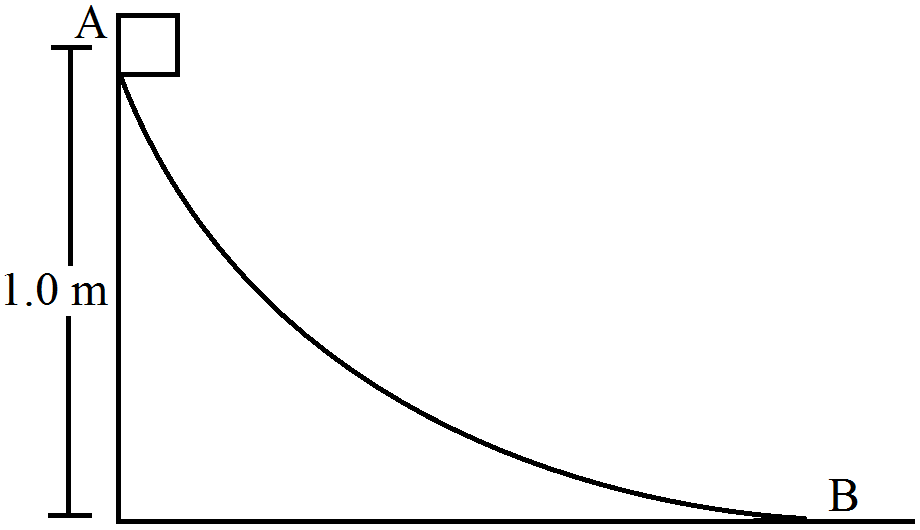
A block weighing 10N travels down a smooth curved track AB joined to a rough horizontal surface (figure). The rough surface has a friction coefficient of 0.20 with the block. If the block starts slipping on the track from a point 1.0m above the horizontal surface, how far will it move on the rough surface?
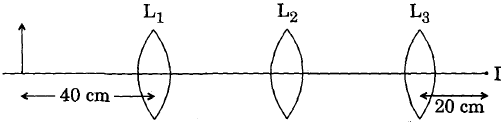
You are given three lenses $L_1, L_2$ and $L_3$ each of focal length $20 \ cm.$ An object is kept at $40 \ cm$ in front of $L_1,$ as shown. The final real image is formed at the focus $I$ of $L_3.$ Find the separations between $L_1, L_2$ and $L_3.$
​​​​​​​
Give explanation of Conductor, Semiconductor and insulator on the basis of band theory.
A 3.0 cm wire carrying of 10 A is placed inside a solenoid perpendicular to its axis. The magnetic field inside the solenoid is given to be 0.27 T. What is the magnetic force on the wire?
Two identically charged particles are fastened to the two ends of a spring of spring constant $100Nm^{-1}$ and natural length $10\ cm.$ The system rests on a smooth horizontal table. If the charge on each particle is $2.0 \times 10^{-8}C$, find the extension in the length of the spring. Assume that the extension is small as compared to the natural length. Justify this assumption after you solve the problem.