Question
State Gauss theorem in electrostatics. Apply this theorem to obtain the expression for the electric field at a point due to an infinitely long, thin, uniformly charged straight wire of linear charge density $\lambda\text{Cm}^{-1}.$

Answer

Gauss Theorem: It states that total electric flux over the closed surface S is $\frac{1}{\in_0}$ times the total charge (q) contained in side S.$\therefore\ \Phi_\text{E}=\oint\limits_{\text{S}}\vec{\text{E}}.\vec{\text{dS}}=\frac{\text{q}}{\in_0}$
Electric field due to infinitely long, thin and uniformly charged straight wire: Consider an infinitely long line charge having linear charge density $\lambda$ coulomb metre$^{-1}$ (linear charge density means charge per unit length). To find the electric field strength at a distance r, we consider a cylindrical Gaussian surface of radius r and length l coaxial with line charge. The cylindrical Gaussian surface may be divided into three parts:
  1. Curved surface $S_1.$
  2. Flat surface $S_2.$
  3. Flat surface $S_3.$
By symmetry, the electric field has the same magnitude E at each point of curved surface $S_1$ and is directed radially outward.
We consider small elements of surfaces $S_1, S_2$ and $S_3$ The surface element vector $\vec{\text{dS}}_1$ is directed along the direction of electric field (i.e., angle between $\vec{\text{E}}$ and $\vec{\text{dS}}_1$ is zero); the elements $\vec{\text{dS}}_2$ and $\vec{\text{dS}}_3$ are directed perpendicular to field vector $\vec{\text{E}}$ (i.e., angle between $\vec{\text{dS}}_2$ and $\vec{\text{E}}$ is 90° and so also angle between $\vec{\text{dS}}_3$ and $\vec{\text{E}}).$
Electric Flux through the cylindrical surface,
Image
$\oint\limits_{\text{S}}\vec{\text{E}}.\vec{\text{dS}}=\oint\limits_{\text{S}_1}\vec{\text{E}}.\vec{\text{dS}_1}+\oint\limits_{\text{S}_2}\vec{\text{E}}.\vec{\text{dS}_2}+\oint\limits_{\text{S}_3}\vec{\text{E}}.\vec{\text{dS}_3}$
$=\oint\limits_{\text{S}_1}{\text{E}}.{\text{dS}_1}\cos0^\circ+\oint\limits_{\text{S}_2}{\text{E}}.{\text{dS}_2}\cos90^\circ+\oint\limits_{\text{S}_3}{\text{E}}.{\text{dS}_3}\cos90^\circ$
$=\oint\text{E dS}_1+0+0$
$=\text{E}\oint\text{dS}_1$ (since electric field E is the same at each point of curved surface)
$=\text{E}2\pi\text{rl}$ (since area of curved surface $=2\pi\text{rl})$
As $\lambda$ is charge per unit length and length of cylinder is l therefore, charge enclosed by assumed surface $=(\lambda\text{l})$
$\therefore$ By Gauss's theorem
$\int\vec{\text{E}}.\vec{\text{dS}}=\frac{1}{\in_0}\times\text{charge enclosed}$
$\Rightarrow\ \text{E}.2\pi\text{rl}=\frac{1}{\in_0}(\lambda\text{l})$
$\Rightarrow\ \text{E}=\frac{\lambda}{2\pi\in_0\text{r}}$
Thus, the electric field strength due to a line charge is inversely proportional to r.

Need a full question paper?

Generate a complete, print-ready paper with questions like this in minutes — across 16+ boards, with answer keys.
Start Generating Free

Similar questions

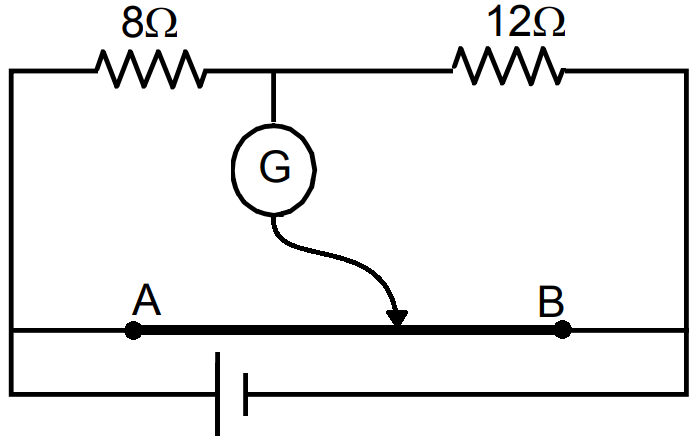
The potentiometer wire AB shown in the figure. is 40cm long. Where should the free end of the galvanometer be connected on AB so that the galvanometer may show zero deflection?
A capacitor of capacitance $10\mu\text{F}$ is connected to a battery of emf 2V. It is found that it takes 50ms for the charge of the capacitor to become $12.6\mu\text{C}.$ Find the resistance of the circuit.
An atom is in its excited state. Does the probability of its coming to ground state depend on whether the radiation is already present or not? If yes, does it also depend on the wavelength of the radiation present?
Consider the Atwood machine of the previous problem. The larger mass is stopped for a moment 2.0s after the system is set into motion. Find the time elapsed before the string is tight again.
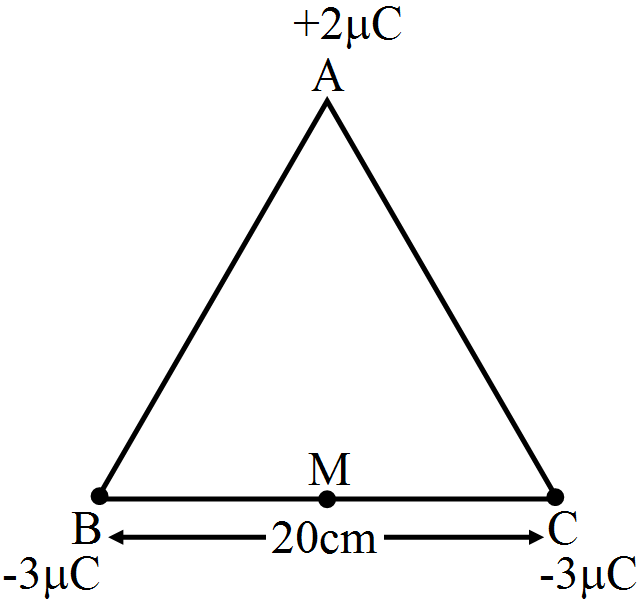
Three point charges of $+2\mu\text{C}, -3\mu\text{C}$ and $-3\mu\text{C}$ are kept at the vertices A, B and C respectively of an equilateral triangle of side 20cm as shown in figure. What should be the sign and magnitude of charge to be placed at the midpoint M of side BC so that charge at A remains in equilibrium?
Write Einstein's photoelectric equation and explain any two observations related to the photoelectric effect.
An ammeter is to be constructed that can read currents up to 2.0A. If the coil has resistance of $25\Omega$ and takes 1mA for full-scale deflection, what should be the resistance of the shunt used?
A capacitor of capacitance $10\mu\text{F}$ is connected to an oscillator with output voltage $\in=(10\text{V})\sin\omega\text{t}.$ Find the peak currents in the circuit for $\omega=10\text{s}^{-1},100\text{s}^{-1},500\text{s}^{-1},1000\text{s}^{-1}.$
A charged particle of charge e and mass m is moving in an electric field E and magnetic field B. Construct dimensionless quantities and quantities of dimension $[T]^{-1}$^.
Consider a neutron and an electron bound to each other due to gravitational force. Assuming Bohr's quantization rule for angular momentum to be valid in this case, derive an expression for the energy of the neutron-electron system.