Question
State Gauss's theorem in electrostatics. State the expression for electric field intensity at a point outside an infinitely long charged conducting cylinder.

Answer

Gauss’s law states that the flux of the electric field through any closed surface S is 1/∈ₒ times the total charge enclosed by S
Let the total flux through a sphere of radius r enclose a point charge q at its centre. Divide the sphere into a small area element as shown in the figure.
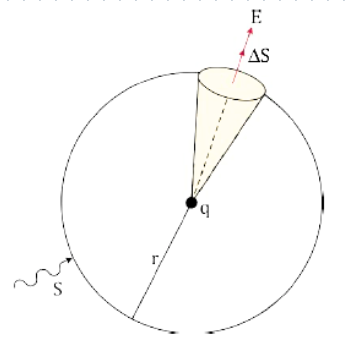
Image
The flux through an area element ΔS is
\(\Delta \phi=E . \Delta S=\frac{q}{4 \pi \in_0 r^2} \hat{r} . \Delta S\)
Here, we have used Coulomb’s law for the electric field due to a single charge q.
The unit vector \(\hat{r}\) is along the radius vector from the centre to the area element. Because the normal to a sphere at every point is along the radius vector at that point, the area element ΔS and \(\hat{r}\) have the same direction. Therefore
\(\Delta \phi=\frac{q}{4 \pi \in_0 r^2} \Delta S\)
Because the magnitude of the unit vector is 1, the total flux through the sphere is obtained by adding the flux through all the different area elements.
\(\phi=\sum_{\text {all } \Delta S} \frac{q}{4 \pi \epsilon_0 r^2} \Delta S\)
Because each area element of the sphere is at the same distance r from the charge,
\(\phi=\frac{q}{4 \pi \in_0 r^2} \sum_{a l l \Delta S} \Delta S=\frac{q}{4 \pi \in_0 r^2} S\)
Now, S the total area of the sphere equals 4πr². Thus,
\(\pi=\frac{q}{4 \pi \epsilon_0 r^2} \times 4 \pi r^2=\frac{q}{\epsilon_0}\)
Hence, the above equation is a simple illustration of a general result of electrostatics called Gauss’s law

Need a full question paper?

Generate a complete, print-ready paper with questions like this in minutes — across 16+ boards, with answer keys.

Start Generating Free

Similar questions

The surface tension of water at \(0^{\circ} C\) is 75.5 dyne \(/ cm\). Find surface tension of water at \(25^{\circ} C\). [a for water \(=0.0021 /{ }^{\circ} C\) ]
A solenoid has a core of material with relative permeability $500$ and its windings carry a current of $1\ A$. The number of turns of the solenoid is $500$ per meter. Calculate the magnetization of the material.
State any two advantages and disadvantages of a photodiode.
Define magnetization. State its formula and S. I. unit.
What is the origin of pressure exerted by a gas on the walls of a container?
A water pipe with a diameter of 5.0 cm is connected to another pipe of diameter 2.5 cm. How would the speeds of the water flow compare ?
In Young's double-slit experiment using light of wavelength 5000 Å, what phase difference corresponds to the 11th dark fringe from the centre of the interference pattern?
The radius of gyration of a body about an axis, at a distance of \(0.4 m\) from its centre of mass is \(0.5 m\). Find its radius of gyration about a parallel axis passing through its centre of mass.
A particle in SHM has a period of 2 seconds and an amplitude of $10 cm$. Calculate its acceleration when it is at $4 cm$ from its positive extreme position.
An ordinary body $A$ and a perfect blackbody $B$ are maintained at the same temperature. If the radiant power of $A$ is $2 \times 10^4 \mathrm{~W} / \mathrm{m}^2$ and that of $B$ is $5 \times 10^4 \mathrm{~W} / \mathrm{m}^2$, what is the coefficient of emission (emissivity) of A ?