Question
State Impulse-momentum theorem.

Answer

The change in momentum associated with a body can be produced by a large force for small time or a small force for large time.

Need a full question paper?

Generate a complete, print-ready paper with questions like this in minutes — across 16+ boards, with answer keys.
Start Generating Free

Similar questions

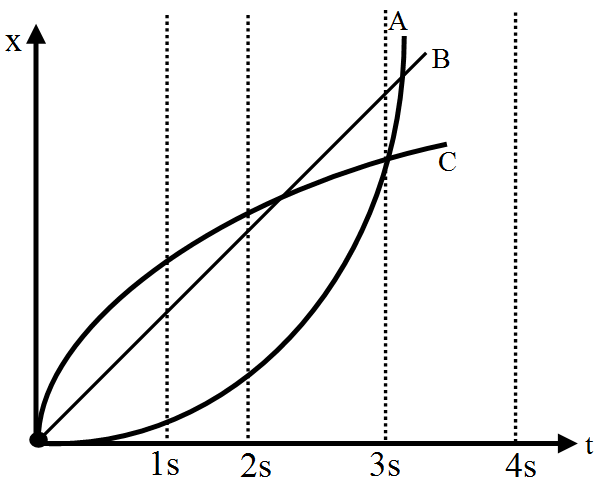
The position-time-graph in figure depicts the journey of three bodies A, B and C.

  1. At 1s, which has the greatest velocity?
  2. At 2s, which has travelled the farthest?
  3. When A meets C, is B moving faster or slower than A?
  4. Is there any time at which the velocity of A is equal to that of B?
Write the equation of a progressive wave propagating along the positive x -direction, whose amplitude is 5 cm , frequency 250 Hz and velocity $500 ms^{-1}$.
An insect trapped in a circular groove of radius $12 cm$ moves along the groove steadily and completes 7 revolutions in $100 s$. (a) What is the angular speed, and the linear speed of the motion? (b) Is the acceleration vector a constant vector? What is its magnitude?
Why are the passengers of a car rounding a curve thrown outward?
Explain the change in the value of $g$ due to shape of the Earth.
If earth contracts to half its radius, what would be the duration of the day? Ans. According to the law of conservation of angular momentum,
The wave $y_1=a \sin (\omega t-k x)$ is superimposed by another wave $y_2=a \sin (\omega t+k x)$ then find the ampli-tude of the resultant wave and also explain what are the condition for the amplitude to be maximum and minimum?
Two spheres of the same external radius and made of the same material are heated to the same temperature one of them is hollow and the other is a solid sphere. Whose temperature will fall faster when cooled?
A diatomic gas is heated in a vessel to a temperature of 10000K. If each molecule possess an average energy E1. After sometime, a few molecule escape into the atmosphere at 300 K. Due to which, their energy changes to E2. Calculate the ratio of $\frac{\text{E}_1}{\text{E}_2}.$
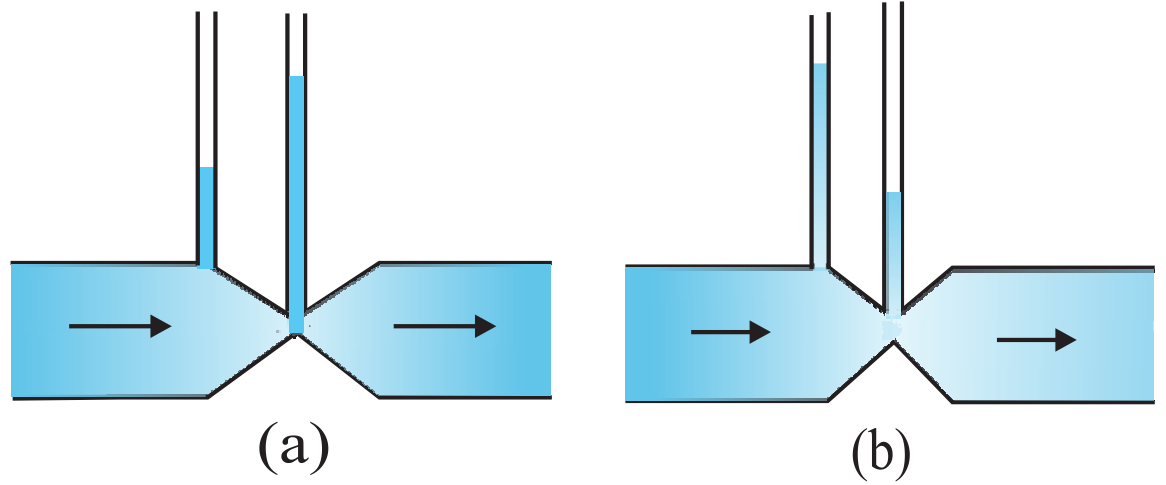
Figures(a) and (b) refer to the steady flow of a (non viscous) liquid. Which of the two figures is incorrect? Why?