Question
State Kepler’s three laws of planetary motion.

Answer

  • All planets move in elliptical orbits around the Sun with the Sun at one of the foci of the ellipse.
  • The line that joins a planet and the Sun sweeps equal areas in equal intervals of time.
  • The square of the time period of revolution of a planet around the Sun is proportional to the cube of the semimajor axis of the ellipse traced by the planet.

Need a full question paper?

Generate a complete, print-ready paper with questions like this in minutes — across 16+ boards, with answer keys.
Start Generating Free

Similar questions

Given below are some famous numbers associated with electromagnetic radiations in different contexts in physics. State the part of the electromagnetic spectrum to which each belongs.
i. 21 cm (wavelength emitted by atomic hydrogen in interstellar space).
ii. 1057 MHz (frequency of radiation arising from two close energy levels in hydrogen known as Lamb Shift).
iii. 5890 A – 5896 A [double lines of sodium]
If $\overrightarrow{ A }=3 \hat{i}+4[$ [latex] $=3 \hat{j}$ and $\overrightarrow{ B }=7 \hat{i}+24 \hat{j}$, find a vector having the same magnitude as $\overrightarrow{ B }$ and parallel to $\overrightarrow{ A }$.
$v=a t+\frac{b}{t+c}+v_0$ is a dimensionally valid equation. Obtain the dimensional formula for $a$, $b$ and $c$ where $v$ is velocity, $t$ is time and $v _0$ is initial velocity.
Mention some main characteristics of gravitational force.
Taking radius of the Earth as $6400 \ km$ and $g$ at the Earth’s surface as $9.8 \ m/s^2,$ calculate the speed of revolution of a satellite orbiting close to the Earth’s surface.
You are sitting next to your friend on ground. Is there any gravitational force of attraction between you two? If so, why are you not coming together naturally? Is any force other than the gravitational force of the earth coming in picture?
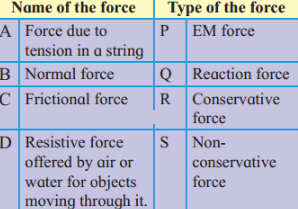
In the following table, every entry on the left column can match with any number of entries on the right side. Pick up all those and write respectively against A, B, C and D.

Image

For an orbiting satellite very close to surface of the Earth, show that $T=2 \pi \sqrt{\frac{ R }{ g }}$.
Answer the following questions regarding earth’s magnetism:
i. Which direction would a compass needlepoint to, if located right on the geomagnetic north or south pole?
ii. Geologists claim that besides the main magnetic N-S poles, there are several local poles on the earth’s surface oriented in different directions. How is such a thing possible at all?
A hiker stands on the edge of a cliff $490 m$ above the ground and throws a stone horizontally with an initial speed of $15 \ ms^{-1}.$ Neglecting air resistance, find the time taken by the stone to reach the ground, and the speed with which it hits the ground. Take $= 9.8 \ m/s^2.$