Question
State Kirchhoff's rules. Explain briefly how these rules are justified.

Answer

Junction rule: At any junction, the sum of the currents entering the junction is equal to the sum of currents leaving the junction.

Alternate Answer

$\sum\text{i} = 0 $

Justification: Conservation of charge.
Loop rule: The Algebraic sum of changes in the potential around any closed loop involving resistors and cells in the loop is zero.

Alternate Answer

$\sumΔ \text{V} =0,$ where Δ V is the changes in potential.

Justification: Conservation of energy.

Need a full question paper?

Generate a complete, print-ready paper with questions like this in minutes — across 16+ boards, with answer keys.
Start Generating Free

Similar questions

Explain the difference between behaviour of a conductor and a dielectric inside external electric field.
A mass of 6 × 1024kg (equal to the mass of the earth) is to be compressed in a sphere in such a way that the escape velocity from its surface is 3 × 10⁸m/s. What should be the radius of the sphere?
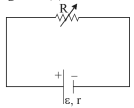
A variable resistor R, electromotive force and internal resistance $r$ are joined as shown in the given figure across the ends of the cell. Draw graph to show (i) terminal voltage and (ii) current $I$ as a function of $R$.
Image
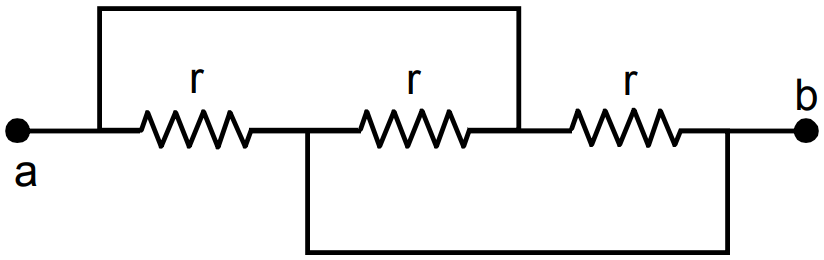
Find the equivalent resistance of the network shown in figure. between the points a and b.

You are facing a circular wire carrying an electric current. The current is clockwise as seen by you. Is the field at the centre coming towards you or going away from you?
Find the maximum kinetic energy of the photoelectrons ejected when light of wavelength 350nm is incident on a cesium surface. Work function of cesium = 1.9eV
Rain is falling vertically. A man running on the road keeps his umbrella tilted but a man standing on the street keeps his umbrella vertical to protect himself from the rain. But both of them keep their umbrella vertical to avoid the vertical sun-rays. Explain.
A small metal sphere with $+Q$ charge is placed in the cavity of a larger uncharged metal sphere. As shown in the Fig. Find the value of electric field intensity at point $P_1$ and $P_2$ from Gauss's law.
A tightly-wound, long solenoid has n turns per unit length, a radius r and carries a current i. A particle having charge q and mass m is projected from a point on the axis in a direction perpendicular to the axis. What can be the maximum speed for which the particle does not strike the solenoid ?
Write the equation of P.E. of electric dipole in external electric field and discuss its special cases.