Question
  1. State Kirchhoff’s rules for an electric network. Using Kirchhoff’s rules, obtain the balance condition in terms of the resistances of four arms of Wheat sone bridge.
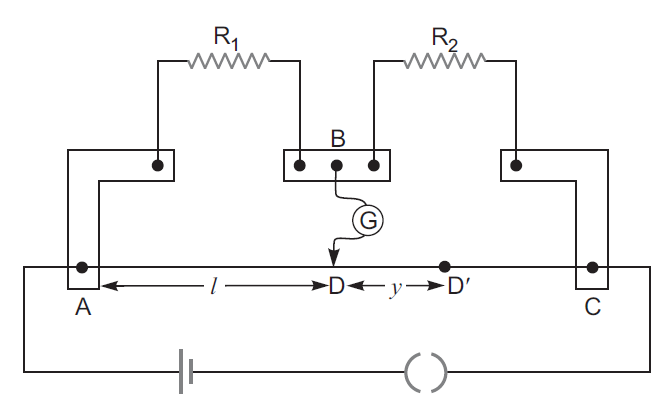
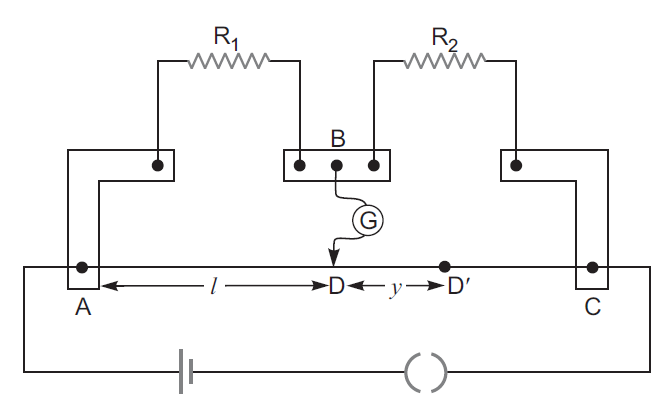
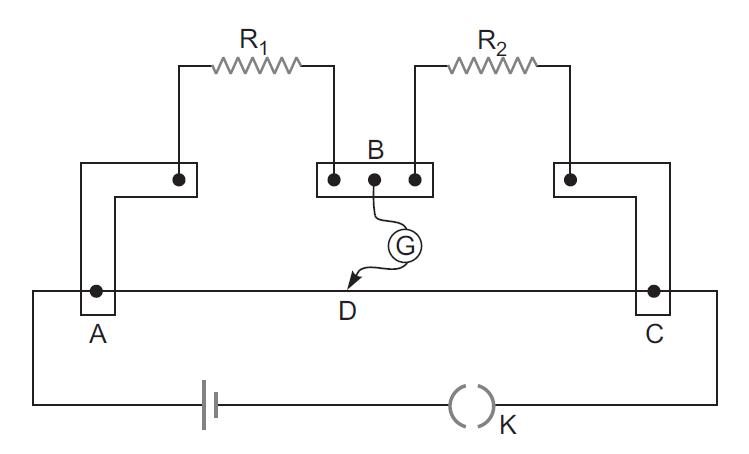
  2. In the meter bridge experimental set up, shown in the figure, the null point $'D\ '$ is obtained at a distance of $40 \ cm$ from end $A$ ofthe meter bridge wire. If a resistance of $10 \Omega$ is connected in series with $R_1,$ null point is obtained at $AD = 60 \ cm$. Calculate the value of $R_1$ and $R_2$.
Answer

  1. Kirchhoff’s Rule
    1. At any junction, the sum of the currents entering the junction is equal to the sum of the currents leaving the junction.
    2. The algebraic sum of the charges in potential around any closed loop involving resistors and cells in the loop is zero.
Condition of balance of a Wheatstone bridge :
The circuit diagram of Wheatstone bridge is shown in fig.
$\text{P, Q, R}$ and $\text{S}$ are four resistance forming a closed bridge, called Wheatstone bridge.
A battery is connected across $A$ and $C,$ while a galvanometer is connected between $B$ and $D$.
At balance, there is no current in galvanometer.
Derivation of Formula :
Let the current given by battery in the balanced position be $I$.
This current on reaching point $A$ is divided into two parts $I_1$ and $I_2$ . .
As there is no current in galvanometer in balanced state, current in resistances $P$ and $Q$ is $I_1$ and in resistances $R$ and $S$ it is $I_2$ .

Applying Kirchhoff’s $I$ law at point $A$
$I - I_1 - I_2 = 0$ or $I = I_1 + I_2 ........ (i)$
Applying Kirchhoff’s $II$ law to closed mesh $\text{ABDA}$
$- I_1P + I_2R = 0$ or $I_1P = I_2 R ........ (ii)$
Applying Kirchhoff’s II law to mesh $\text{BCDB}$
$- I_1Q + I_2S = 0$ or $I_1Q = I_2S ....... (iii)$
Dividing equation $(ii)$ by $(iii),$ we get
$\frac{\text{I}_{1}\text{P}}{\text{I}_{1}\text{Q}} = \frac{\text{I}_{2}\text{R}}{\text{I}_{2}\text{S}}$ or $\frac{\text{P}}{\text{Q}} = \frac{\text{R}}{\text{S}} .........(iv)$
This is the condition of balance of Wheatstone bridge.
  1.  

For null point at $D,$ balance length $\ell_{1} = 40 \ cm$
So, $\frac{\text{R}_{1}}{\text{R}_{2}} = \frac{\text{AD}}{\text{DC}} =\frac{40}{(100- 40)} = \frac{2}{3} ........ (i)$
If resistance 10 $\Omega$ is connected in series of $R_1,$ then balance length $AD\ '  >  AD$ i.e. balance point shifts by length $'y\ '$ towards $C$ i.e.$, AD = 60 \ cm.$
$\frac{\text{R}_{1} + 10}{\text{R}_{2}} = \frac{\text{AD}"}{\text{D}'\text{C}} = \frac{60}{100-60} = \frac{3}{2}$
$\frac{\text{R}_{1}}{\text{R}_{2}} + \frac{10}{\text{R}_{2}} =\frac{3}{2} ......... (ii)$
From equations $(1)$ and $(2),$ we have
$\frac{2}{3} +\frac{10}{\text{R}_{2}} =\frac{3}{2}$
$\frac{10}{\text{R}_{2}} = \frac{3}{2} - \frac{2}{3} =\frac{9-4}{6} = \frac{5}{6}$
$\Rightarrow\text{R}_{2} = \frac{ 10\times6}{5} = 12\text{ ohm}$
From equation $(1),$ we have
$\frac{\text{R}_{1}}{12} = \frac{2}{3}$
$\Rightarrow\text{R}_{1} $
$= \frac{12\times2}{3} =8\text{ ohm}.$

Need a full question paper?

Generate a complete, print-ready paper with questions like this in minutes — across 16+ boards, with answer keys.

Start Generating Free

Similar questions

(i) How will you show that Lenz's law is a conclusion of energy conservation law? Explain with suitable examples.

(ii) Using the expression for Lorentz force applied on charge carriers of any conductor, obtain an expression for that induced emf which is induced in a conductor of length $l$ moving with a velocity $v$, perpendicular to any magnetic field $B$.
Doubly$-$ionised helium ions are projected with a speed of $10\ km/s^{-1}$ in a direction perpendicular to a uniform magnetic field of magnitude $1.0T.$ Find
  1. The force acting on an ion.
  2. The radius of the circle in which it circulates.
  3. The time taken by an ion to complete the circle.
  1. Draw the circuit diagrams of a $p-n$ junction diode in $(i)$ forward bias$, (ii)$ reverse bias. How are these circuits used to study the $V - I$ characteristics of a silicon diode? Draw the typical $V - I$ characteristics.
  2. What is a light emitting diode $\text{(LED)}$? Mention two important advantages of $\text{LEDs}$ over conventional lamps.
An object is placed at a distance of 30cm from a converging lens of focal length 15cm. A normal eye (near point 25cm, far point infinity) is placed close to the lens on the other side.
  1.  Can the eye see the object clearly?
  2.  What should be the minimum separation between the lens and the eye so that the eye can clearly see the object?
  3.  Can a diverging lens, placed in contact with the converging lens, help in seeing the object clearly when the eye is close to the lens?
The activity R of an unknown radioactive nuclide is measured at hourly intervals. The results found are tabulated as follows:
t(h) 0 1 2 3 4
R(MBq) 100 35.36 12.51 4.42 1.56
  1. Plot the graph of R versus t and calculate half-life from the graph.
  2. Plot the graph of 0 ln $\Big(\frac{\text{R}}{\text{R}_0}\Big)$ versus t and obtain the value of half-life from the graph.
Deutrium was discovered in $1932$ by Harold Urey by measuring the small change in wavelength for a particular transition in $1H$ and $2H$. This is because, the wavelength of transition depend to a certain extent on the nuclear mass. If nuclear motion is taken into account then the electrons and nucleus revolve around their common centre of mass. Such a system is equivalent to a single particle with a reduced mass $\mu ,$ revolving around the nucleus at a distance equal to the electron $-$ nucleus separation. Here $\mu=\frac{\text{m}_\text{e}\text{M}}{\text{m}_\text{e}+\text{M}}$ where $M$ is the nuclear mass and me is the electronic mass. Estimate the percentage difference in wavelength for the $1^{st}$ line of the Lyman series in $1H$ and $2H. ($Mass of $1H$ nucleus is $1.6725 \times 10^{-27}kg,$ Mass of $2H$ nucleus is $3.3374 \times 10^{-27}kg$, Mass of electron $= 9.109 \times 10^{-31}kg).$
$^{238}U$ decays to $^{206}Pb$ with a half-life of $4.47 \times 10^9y.$ This happens in a number of steps. Can you justify a single half for this chain of processes? A sample of rock is found to contain $2.00\ mg$ of $^{238}U$ and $0.600\ mg$ of $^{206}Pb.$ Assuming that all the lead has come from uranium, find the life of the rock.
A particle slides on the surface of a fixed smooth sphere starting from the topmost point. Find the angle rotated by the radius through the particle, when it leaves contact with the sphere.
A charge of $1\mu\text{C}$ is given to one plate of a parallel-plate capacitor of capacitance $0.1\mu\text{F}$ and a charge of $2\mu\text{C}$ is given to the other plate. Find the potential difference developed between the plates.
A capacitor is formed by two square metal $-$ plates of edge a, separated by a distance $d$. Dielectrics of dielectric constants $K_1$ and $K_2$ are filled in the gap as shown in figure. Find the capacitance.