State Kirchhoff's rules of current distribution in an electrical network. Using these rules determine the value of the current I1 in the electric circuit given below.
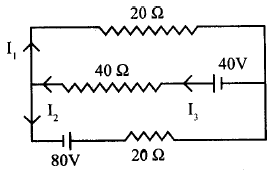
CBSE DELHI - SET 1 2007
Download our app for free and get startedPlay store
Junction Rule: At any junction of several circuit elements the sum of currents entering the junction must be equal to the sum of currents leaving it.Loop Rule: Algebraic sum of changes in the potential around any closed loop must be zero.
 

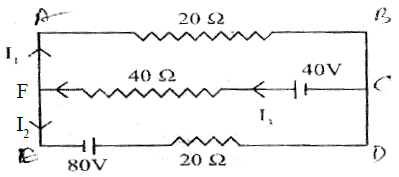
Loop ABCFA
$\text{I}_{1} + 2\text{I}_{3} = 2 ........................$ (1)
Loop FCDEF
$2\text{I}_{3} + \text{I}_{2} = 6 .................................$(2)
At F, $\text{I}_{1} + \text{I}_{2} = \text{I}_{3} ........................................$(3)
Solving (1), (2) and (3)
$\text{I}_{1} = - 0.8 \text{A}$
art

Download our app
and get started for free

Experience the future of education. Simply download our apps or reach out to us for more information. Let's shape the future of learning together!No signup needed.*

Similar Questions

  • 1
    The specification on a heater coil is 250V, 500W. Calculate the resistance of the coil. What will be the resistance of a coil of 1000W to operate at the same voltage?
    View Solution
  • 2
    1. The potential difference applied across a given resistor is altered so that the heat produced per second increases by a factor of 9. By what factor does the applied potential difference change?
    2. In the figure shown, an ammeter A and a resistor of $4\Omega$ are connected to the terminals of the source. The emf of the source is 12 V having an internal resistance of $2\Omega$. Calculate the voltmeter and ammeter readings.
    View Solution
  • 3
    A capacitor of capacitance $10\mu\text{F}$ is connected across a battery of emf 6.0V through a resistance of $20\text{k}\Omega$ for 4.0s. The battery is then replaced by a thick wire. What will be the charge on the capacitor 4.0s after the battery is disconnected?
    View Solution
  • 4
    Given $n$ resistors each of resistance $$R, how will you combine them to get the $(i)$ maximum $(ii)$ minimum effective resistance? What is the ratio of the maximum to minimum resistance?
    View Solution
  • 5
    An electric toaster uses nichrome for its heating element. When a negligibly small current passes through it, its resistance at room temperature $\left(27.0^{\circ} C \right)$ is found to be $75.3 \Omega$. When the toaster is connected to a $230 V$ supply, the current settles, after a few seconds, to a steady value of $2.68 A$. What is the steady temperature of the nichrome element? The temperature coefficient of resistance of nichrome averaged over the temperature range involved, is $1.70 \times 10^{-4}{ }^{\circ} C ^{-1}$.
    View Solution
  • 6
    What is end error in a metre bridge? How is it overcome? The resistances in the two arms of the metre bridge are $\text{R}=5\Omega$ and $S$ respectively. When the resistance $S$ is shunted with an equal resistance, the new balance length found to be $1.5 l_1 ,$ where $l_1$ is the initial balancing length. Calculate the value of $S.$
    View Solution
  • 7
    Do all the thermocouples have a neutral temperature?
    View Solution
  • 8
    Define relaxation time of the free electrons drifting in a conductor. How is it related to the drift velocity of free electrons? Use this relation to deduce the expression for the electrical resistivity of the material. 
    View Solution
  • 9
    Electrons are continuously in motion within a conductor but there is no current in it unless some source of potential is applied across its ends. Give reason.
    View Solution
  • 10
    1. Define the term ‘conductivity’ of a metallic wire. Write its SI unit.
    2. Using the concept of free electrons in a conductor, derive the expression for the conductivity of a wire in terms of number density and relaxation time. Hence obtain the relation between current density and the applied electric field E.
    View Solution