Question
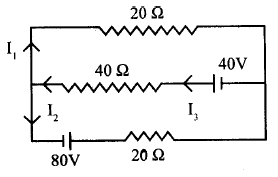
State Kirchhoff's rules of current distribution in an electrical network. Using these rules determine the value of the current I1 in the electric circuit given below.
Answer

Junction Rule: At any junction of several circuit elements the sum of currents entering the junction must be equal to the sum of currents leaving it.

Loop Rule: Algebraic sum of changes in the potential around any closed loop must be zero.
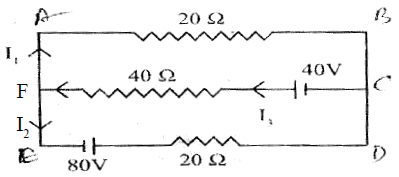
 

Loop ABCFA

$\text{I}_{1} + 2\text{I}_{3} = 2 ........................$ (1)

Loop FCDEF

$2\text{I}_{3} + \text{I}_{2} = 6 .................................$(2)

At F, $\text{I}_{1} + \text{I}_{2} = \text{I}_{3} ........................................$(3)

Solving (1), (2) and (3)

$\text{I}_{1} = - 0.8 \text{A}$

Need a full question paper?

Generate a complete, print-ready paper with questions like this in minutes — across 16+ boards, with answer keys.
Start Generating Free

Similar questions

If the operating potential in an X-ray tube is increased by 1%, by what percentage does the cutoff wavelength decrease?
A circular loop of radius R carries a current I. Another circular loop of radius r ( << R) carries a current i and is placed at the centre of the larger loop. The planes of the two circles are at right angle to each other. Find the torque acting on the smaller loop.
A concave mirror of radius R is kept on a horizontal. Water $\big($refractive index $=\mu\big)$ is poured into it upto a height h. Where should an object be placed so that its image is formed on itself?

An ammeter and a milliammeter are converted from the same galvanometer. Out of the two, which current measuring instrument has a higher resistance?
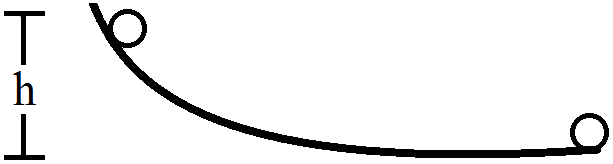
A small spherical ball is released from a point at a height h on a rough track shown in figure. Assuming that it does not slip anywhere, find its linear speed when it rolls on the horizontal part of the track.

Write Gauss's law and explain.
Consider the situation shown in figure. What are the signs of q1 and q2? If the lines are drawn in proportion to the charge, what is the ratio $\frac{\text{q}_1}{\text{q}_2}?$

A capacitance C charged to a potential difference V is discharged by connecting its plates through a resistance R. Find the heat dissipated in one time constant after the connections are made. Do this by calculating $\int\text{i}^2\text{R}$ dt and also by finding the decrease in the energy stored in the capacitor.
When a photon is emitted from an atom, the atom recoils. The kinetic energy of recoil and the energy of the photon come from the difference in energies between the states involved in the transition. Suppose, a hydrogen atom changes its state from n = 3 to n = 2. Calculate the fractional change in the wavelength of light emitted, due to the recoil.
With what considerations in view, a photodiode is fabricated? State its working with the help of a suitable diagram.
Eventhough the current in the forward bias is known to be more than in the reverse bias, yet the photodiode works in reverse bias. What is the reason?