Question
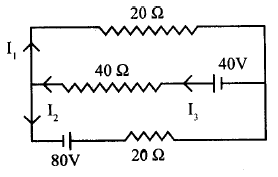
State Kirchhoff's rules of current distribution in an electrical network. Using these rules determine the value of the current I1 in the electric circuit given below.
Answer

Junction Rule: At any junction of several circuit elements the sum of currents entering the junction must be equal to the sum of currents leaving it.Loop Rule: Algebraic sum of changes in the potential around any closed loop must be zero.

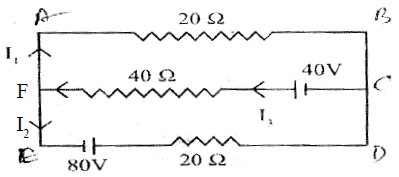
Loop ABCFA
$\text{I}_{1} + 2\text{I}_{3} = 2 ........................$ (1)
Loop FCDEF
$2\text{I}_{3} + \text{I}_{2} = 6 .................................$(2)
At F, $\text{I}_{1} + \text{I}_{2} = \text{I}_{3} ........................................$(3)
Solving (1), (2) and (3)
$\text{I}_{1} = - 0.8 \text{A}$

Need a full question paper?

Generate a complete, print-ready paper with questions like this in minutes — across 16+ boards, with answer keys.

Start Generating Free

Similar questions

In a children's park a heavy rod is pivoted at the centre and is made to rotate about the pivot so that the rod always remains horizontal. Two kids hold the rod near the ends and thus rotate with the rod (fig). Let the mass of each kid be 15 kg, the distance between the points of the rod where the two kids hold it be 3.0 m and suppose that the rod rotates at the rate of 20 revolutions per minute. Find the force of friction exerted by the rod on one of the kids.
In a pure semiconductor, the number of conduction electrons is $6 \times 10^{19}$ per cubic metre. How many holes are there in a sample of size $1cm × 1cm × 1mm?$
A boy is holding a smooth, hollow and non-conducting pipe vertically with charged spherical ball of mass 10 g carrying a charge of +10 mC inside it which is free to move along the axis of the pipe. The boy is moving the pipe from East to West direction in the presence of magnetic field of 2T. With what minimum velocity, should the boy move the pipe such that the ball does not move along the axis. Also determine the direction of the magnetic field.
In the study of a photoelectric effect, the graph between the stopping potential $V$ and frequency of the incident radiation on two different metals $P$ and $Q$ is shown below.
Image

$i.$ Which one of the two metals has higher threshold frequency?
$ii.$ Determine the work function of the metal which has greater value.
A uniform magnetic field of magnitude 0.20T exists in space from east to west. With what speed should a particle of mass 0.010g and with charge $1.0 \times 10^{-5}C$ be projected from south to north so that it moves with uniform velocity?
A spherical shell made of plastic, contains a charge Q distributed uniformly over its surface. What is the electric field inside the shell? If the shell is hammered to deshape it without altering the charge, will the field inside be changed? What happens if the shell is made of a metal?
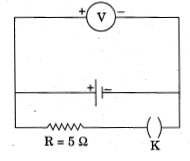
Write any two factors on which internal resistance of a cell depends. The reading on a high resistance voltmeter, when a cell is connected across it, is 2.2 V. When the terminals of the cell are also connected to a resistance of 5 Ω as shown in the circuit, the voltmeter reading drops to 1.8 V. Find the internal resistance of the cell.
Mention the important considerations required while fabricating a p-n junction diode to be used as a Light Emitting Diode (LED). What should be the order of band gap of an LED if it is required to emit light in the visible range?
If heavier bodies are attracted more strongly by the earth, why don't they fall faster than the lighter bodies?
Let AE denote the energy gap between the valence band and the conduction band. The population of conduction electrons (and of the holes) is roughly proportional to $\text{e}^{\frac{-\Delta\text{E}}{2\text{kT}}}.$ Find the ratio of the concentration of condu.ction electrons in diamond to that in silicon at room temperature 300K. $\Delta\text{E}$ for silicon is 1.1eV and for diamond is 6.0eV. How many conduction electrons are likely to be in one cubic metre of diamond?