Question
State the causes of difference occurred due to time lag.

Answer

The causes of difference which occur because of time lag are given below:
  1. Cheques issued but not presented for payment at the bank: The firm/ customer issues cheques to its suppliers or creditors. But not all these cheques are presented to the bank. The entry in the cash book is made immediately on issue of the cheque but the bank will not pass an entry until the cheque is presented for payment.
  2. Cheques paid or deposited but not collected and credited by the bank: Entry is passed by the firm in the cash book when it receives cheques from its debtors which increase the balance as per the cash book. But the bank credits the firm’s account only when they have received the payment from the customer’s bank or in other words, once the cheque is collected by the bank.

Need a full question paper?

Generate a complete, print-ready paper with questions like this in minutes — across 16+ boards, with answer keys.
Start Generating Free

Similar questions

Cash Basis of Accounting is not a better basis for depicting the correct financial position of an enterprise. Do you agree? Give reasons in support of your answer.
Briefly explain the term ‘favourable balance as per cash book’
Explain 'Comparability' as qualitative characteristics of accounting information.
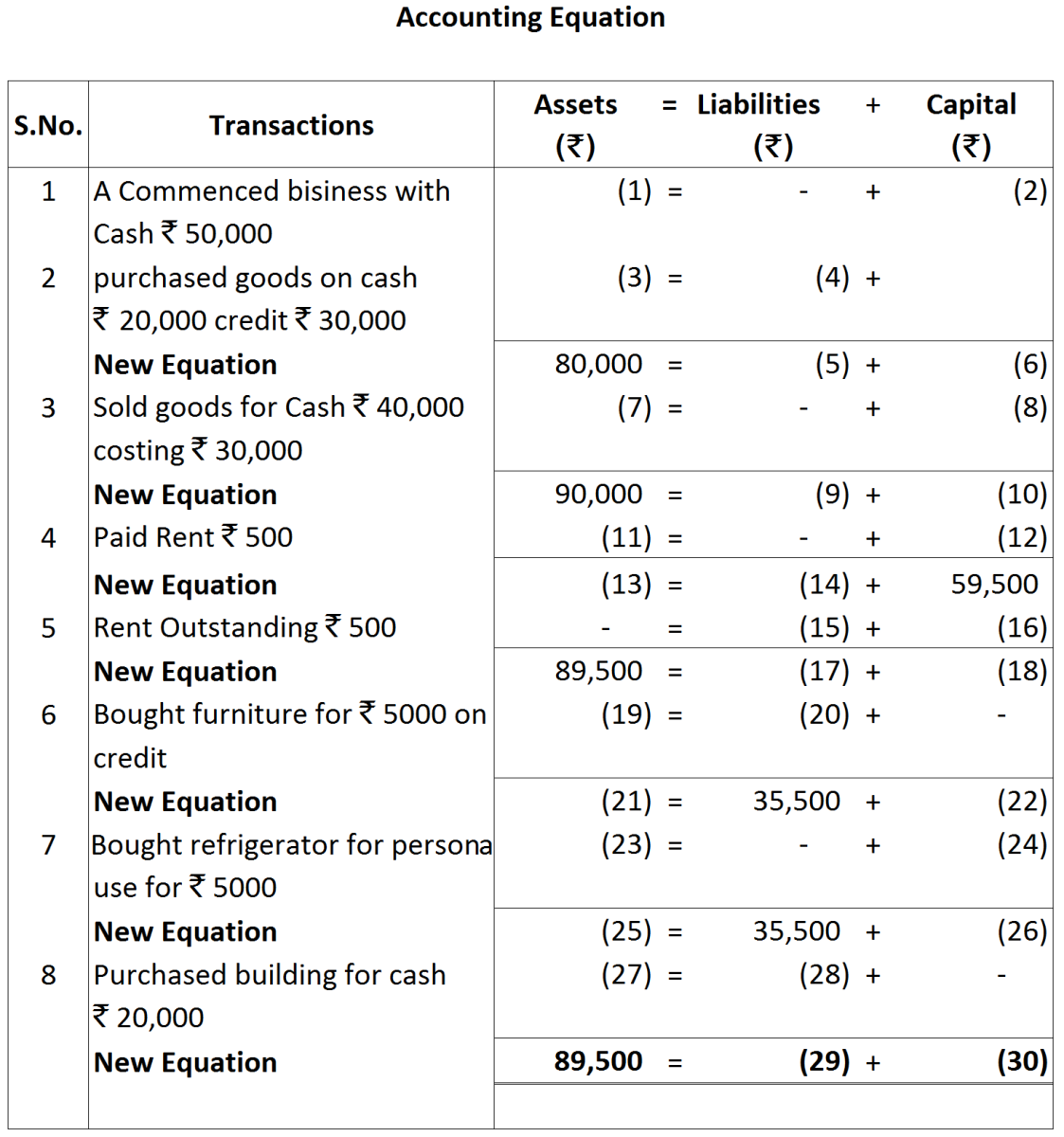
Complete the following Accounting Equation by filling the missing ammount:
Oswal Woollen Mills, Amritsar (Punjab) sold shawls to Gupta Shawls, Jaipur as per details: Sold 100 shawls @ ₹ 200 per shawl on 4th January, 2019, IGST is levied @ 12%. Trade Discount 25% and Cash Discount 5% if full payment is made within 14 days. Gupta Shawls sent 50% of the payment on 14th January, 2019 and balance payment on 10th February, 2019. Pass Journal entries.
Journalise the following:
  1. Received a V.P.P. from Mohan Lal for ₹ 25,000. Sent a peon to collect it who paid ₹ 200 as cartage.
  2. Received ₹ 1,000 from sales of old newspapers and ₹ 5,000 from sales of old chairs.
  3. Goods given away as charity goods costing ₹ 7,000.
  4. Received Cash from a debtor written off as bad-debt last year ₹ 20,000.
  5. Sold goods costing ₹ 50,000 to Ashok on credit at a profit of 20% on cost.
  6. Sold goods costing ₹ 1,00,000 for ₹ 1,40,000.
  7. Provide ₹ 50,000 as interest on Capital.
  8. Paid rent of building ₹ 60,000 by cheque. Half the building is used by the proprietor for residential purpose.
  9. Outstanding salary at the end of the year ₹ 30,000.
Pass entries in the books of Mukerjee & Sons. assuming all transactions have taken place within the state of Uttar Pradesh. Assume CGST @ 9% and SGST @ 9%.
2018
 
March 1
Purchased goods for ₹ 5,00,000 from Mehta Bros.
March 10
Sold goods for ₹ 8,00,000 to Munjal & Co.
March 15
Paid for advertisement ₹ 40,000 by cheque.
March 18
Purchased furniture for office use ₹ 50,000 and payment made by cheque.
March 25
Paid for printing and stationery ₹ 8,000.
March 31
Payment made of balance amount of GST.
Give one distinction between books of original entry and ledger. Ledger.
Journalise the following transactions:
2018
 
April 1
Purchased goods for ₹ 1,00,000 from Manoj and availed discount of ₹ 10,000
April 2
Paid amount due to Manoj by cheque and availed discount of ₹ 4,500
April 5
Cash ₹ 5,000 paid to Desai and discount allowed by him ₹ 200
April 10
Cash ₹ 10,000 received from Govardhan and allowed him discount ₹ 500.
April 12
Sold personal Car of the proprietor for ₹ 80,00 against cheque, which was deposited into the firm's bank account.
April 16
Sold personal Car of the proprietor for ₹ 1,50,000 against cheque, which was deposited into the proprietor's personal bank account.
April 20
Sold goods to Gaurav costing ₹ 1,00,000 at a profit of 40% and allowed him 10% trade discount and paid for cartage ₹ 3,000 not to be charged from him.
April 24
Placed an order with Rudra & Co. for supply of goods of ₹ 80,000 and a cheque for 40% amount is sent to them as an advance.
Rohit has the following transactions:
a.
Commenced business with cash
₹ 1,50.000
b.
Purchased machinery on credit
₹ 40,000
c.
Purchased goods for cash
₹ 20,500
d.
Purchased car for personal use
₹ 80,000
e.
Paid to creditors in full settlement
₹ 38,000
f.
Sold goods for cash costing ₹ 5,000
₹ 4,500
g.
Paid rent
₹ 1,000
h.
Commission received in advance
₹ 2,000
(Ans: Assets = Cash ₹ 17,500 + Machine ₹ 40,000 + Goods ₹ 15,000 = ₹ 72,500; Liabilities = Commission ₹ 2,000 + Capital ₹ 70,500 = ₹ 72,500)