Question
State the chief functions of mitochondria.

Answer

Mitochondria perform the following major functions:
  1. Mitochondria are the main site of aerobic respiration, where respiratory substrates are completely oxidised to carbon dioxide and water. The energy liberated in the process is utilised in the synthesis of energy rich molecules ATP.
  2. They have a group of enzymes that carry out elongation of fatty acids of adding acetyl Co-A and subsequently reducing the keto-acid and produced.
  3. The matrix of mitochondria has enzymes for the synthesis of fatty acids.

Need a full question paper?

Generate a complete, print-ready paper with questions like this in minutes — across 16+ boards, with answer keys.

Start Generating Free

Similar questions

Which features make mammals as the most successful and dominant animals?
Distinguish between Red, Brown and Green Algae.
Describe the role of haemoglobin in the transport of respiratory gases.
Describe in detail the events in Prophase I of meiosis.
Sumit, student of class XI when returned from school was told by his mother that his grandfather was complaining about some uneasiness. Sumit told his mother to take him to the doctor. The doctor tied a cuff around his arm and pumped air, then he slowly released the air. The handcuff was connected to a tube containing mercury. Doctor told Sumit that his grandfather is suffering from high blood pressure and put him on medication. The doctor also advised him to take precautions and rest and asked Sumit's mother to bring him for regular checkups.
  1. What is meant by blood pressure?
  2. What is the harmful effect of blood pressure on health?
  3. Enumerate the range of normal and high blood pressure in human.
  4. What values are displayed by Sumit as a good grandson?
Describe the following as asked against each:
  1. Gizzard in cockroach: Function
  2. Open type of vascular system: One example
  3. Heart: Name of tissue.
Explain the guidelines/ principles for nomenclature.
Match the following
 
Column I
 
Column II
a.
Cristae
i.
Flat membranous sacs in stroma.
b.
Cisternae
ii.
Infoldings in mitochondria.
c.
Thylakoids
iii.
Disc-shaped sacs in Golgi apparatus.
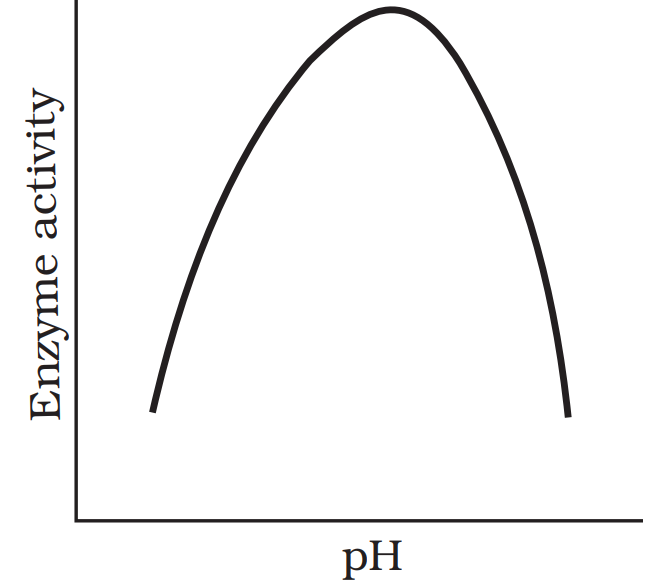
Enzymes are proteins. Proteins are long chains of aminoacids linked to each other by peptide bonds. Aminoacids have many functional groups in their structure. These functional groups are, many of them at least, ionisable. As they are weak acids and bases in chemical nature, this ionization is influenced by pH of the solution. For many enzymes, activity is influenced by surrounding pH. This is depicted in the curve below, explain briefly.
A group of plants lacks photorespiration. Answer the following questions based on these plants.
  1. Which cells in the plant have RuBisCO?
  2. Does photorespiration occur in these plants?
  3. In which cells the $\mathrm{CO}_2$ fixation initially occurs.