Question
  1. State the condition under which a large magnification can be achieved in an astronomical telescope.
  2. Give two reasons to explain why a reflecting telescope is preferred over a refracting telescope.

Answer

  1. $m=-\frac{f_0}{f_e}$

By increasing 𝑓0 / decreasing 𝑓𝑒

  1.  
  1. No chromatic aberration.
  2. No spherical aberration.
  3. Mechanical advantage – low weight, easier to support.
  4. Mirrors are easy to prepare.
  5. More economical.

Need a full question paper?

Generate a complete, print-ready paper with questions like this in minutes — across 16+ boards, with answer keys.
Start Generating Free

Similar questions

1 F (farad) is a very large unit for practical purposes. Explain with example.
An object is placed at the principal focus of a concave lens of focal length f. Where will its image be formed?
$\frac{1}{\text{f}}=\frac{1}{\text{v}}-\frac{1}{\text{u}}$
$\Rightarrow\frac{1}{\text{v}}=\frac{1}{\text{f}}+\frac{1}{\text{u}}$
What is the radius of the path of an electron (mass $9 \times 10^{-31} kg$ and charge $1.6 \times 10^{-19} C$ ) moving at a speed of $3 \times 10^7 m / s$ in a magnetic field of $6 \times 10^{-4} T$ perpendicular to it? What is its frequency? Calculate its energy in $keV .\left(1 eV =1.6 \times 10^{-19} J \right)$.
A person drops a coin. Describe the path of the coin as seen by the person if he is in:
  1. A car moving at constant velocity.
  2. In a freely falling elevator.
In a Young's double slit experiment, two narrow vertical slits placed 0.800mm apart are illuminated by the same source of yellow light of wavelength 589nm. How far are the adjacent bright bands in the interference pattern observed on a screen 2.00m away?
The contact angle between water and glass is 0º. When water is poured in a glass to the maximum of its capacity, the water surface is convex upward. The angle of contact in such a situation is more than 90º. Explain.
Draw the graph of variation in potential difference and electric field with distance ' $r$ ' for a point electric charge $Q$.
You are facing a circular wire carrying an electric current. The current is clockwise as seen by you. Is the field at the centre coming towards you or going away from you?
Explain the Rutherford atomic model and its limitations.
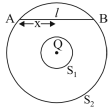
Calculate the electric flux passing through the spheres $S_1$ and $S_2$ shown in the figure. The linear charge density of the wire $A B$ shown in the figure is $\lambda=K x$ where $x=$ distance from the end $A$ of the wire measured along its length.
Image