Question
State the condition when the work done by a force is positive. Explain with the help of examples.

Answer

If the displacement of the body is in the direction of force, then work done is positive.
Hence, W= F x S
For example: A coolie does work on the load when he raises it up against the force of gravity. The force exerted by coolie (=mg) and displacement, both are in upward direction.

Need a full question paper?

Generate a complete, print-ready paper with questions like this in minutes — across 16+ boards, with answer keys.
Start Generating Free

Similar questions

A battery of e.m.f 3.0 V supplies current through a circuit in which the resistance can be changed.
A high resistance voltmeter is connected across the battery. When the current is 1.5 A, the voltmeter reads 2.7 V. Find the internal resistance of the battery.
A boy fires a gun and hears the echo 2 seconds later. If he is 480 m away from a wall, calculate the velocity of sound in air.
How is it possible to detect the filling of a bottle under a water tap by hearing the sound at a distance?
What determines the pitch of a sound?
What is dissipation of energy?
If the potential differences between two parts of a thundercloud is $10s V,$
what is the amount of energy given up during the passage of $20$ coulombs?(a)$2x10⁻⁷J$
$(b)200J$
$(c)Sx106 j$
$(d)2x 10⁹J$
$(e)2x 10¹⁰ J$
A metal ball of specific heat capacity $400 Jkg ^{-1}{ }^{\circ} C ^{-1}$ is allowed to fall from a height of 100 m . If the ball on hitting the ground stops and all the energy possessed by it is converted into heat energy, calculate the rise in temperature of the ball. [Take $g -10 ms^{-2}$ ].
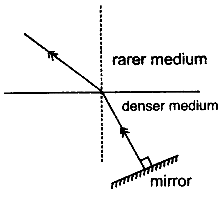
A ray of light is moving from a rarer medium to a denser medium and strikes a plane mirror placed at 90° to the direction of the ray as shown in the diagram.

(i) Copy the diagram and mark arrows to show the path of the ray of light after it is reflected from the mirror. (ii) Name the principle you have used to mark the arrows to show the direction of the ray.
A ball of mass $0.20 \ kg$ is thrown vertically upwards with an initial velocity of $20 \ m s^{-1}.$ Calculate the maximum potential energy it gains as it goes up.
A piece of iron of mass 2.0 kg has a thermal capacity of 966 J/°C. What is its specific heat capacity in S.I. units?