Question
State the important points of Gauss's law.

Answer

►(i) Gauss's law is true for any closed surface, no matter what its shape or size is.
As per Gauss's law, $\phi=\int \overrightarrow{ E } \cdot \overrightarrow{ dS }=\frac{\sum q}{\varepsilon_0}$
(ii) The term q on the right side of Gauss's law, Eq. (1), includes the sum of all charges enclosed by the surface. The charges may be located anywhere inside the surface.
(iii) In the situation when the surface is so chosen that there are some charges inside and some outside, the electric field [whose flux appears on the left side of Eq. (1)] is due to all the charges, both inside and outside S . The term q on the right side of Gauss's law, however, represents only the total charge inside S .
(iv) The surface that we choose for the application of Gauss's law is called the Gaussian surface. You may choose any Gaussian surface and apply Gauss's law.
(v) Gauss's law is often useful towards a much easier calculation of the electrostatic field when the system has some symmetry. This is facilitated by the choice of a suitable Gaussian surface.
(vi) Finally, Gauss's law is based on the inverse square dependence on distance contained in the Coulomb's law.

Need a full question paper?

Generate a complete, print-ready paper with questions like this in minutes — across 16+ boards, with answer keys.

Start Generating Free

Similar questions

Power P is to be delivered to a device via transmission cables having resistance $R_C$. If V is the voltage across R and I the current through it, find the power wasted and how can it be reduced.
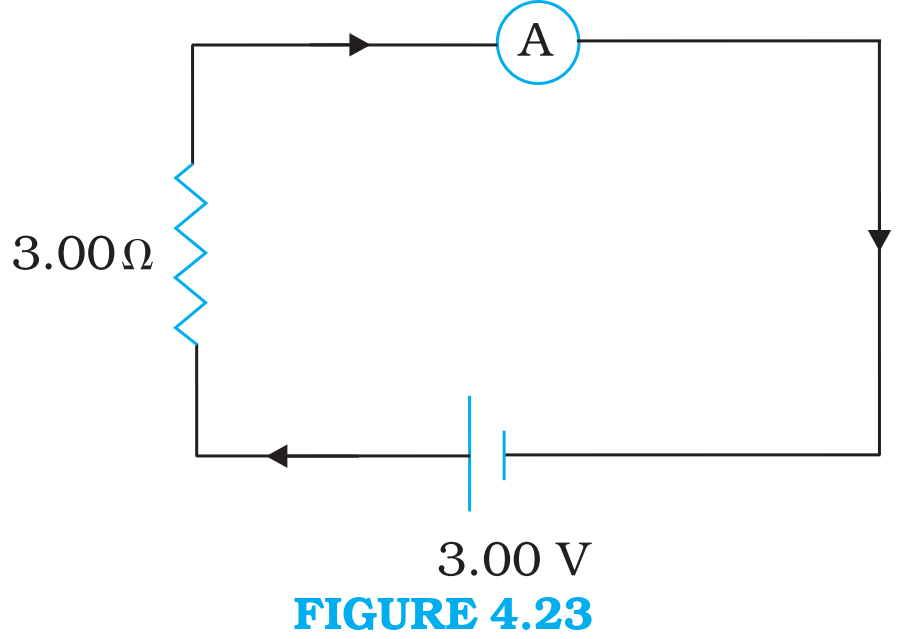
In the circuit (Fig. 4.23) the current is to be measured. What is the value of the current if the ammeter shown (a) is a galvanometer with a resistance $R_G=60.00 \Omega$; (b) is a galvanometer described in (a) but converted to an ammeter by a shunt resistance $r_s=0.02 \Omega$; (c) is an ideal ammeter with zero resistance?
Image
Two point electric charges of unknown magnitude and sign are placed at some distance ‘d’ apart. The electric field intensity is zero at a point, not between the charges but on the line joining them.
Write two essential conditions for this to happen.
Write characteristics of electro magnetic waves.
Draw a plot showing the variation of (i) electric field (E) and (ii) electric potential (V) with distance r due to a point charge Q.
On what does the work function of a metal depend?
Three sources of sound $S_1, S_2$ and $S_3$ of equal intensity are placed in a straight line with $\mathrm{S}_1 \mathrm{~S}_2=\mathrm{S}_2 \mathrm{~S}_3$ figure. At a point $P$, far away from the sources, the wave coming from $S$ is $120^{\circ}$ ahead in phase of that from $S_1$. Also, the wave coming from $\mathrm{S}_3$ is $120^{\circ}$ ahead of that from $\mathrm{S}_2$. What would be the resultant intensity of sound at P ?
A gas thermometer measures the temperature from the variation of pressure of a sample of gas. If the pressure measured at the melting point of lead is 2.20 times the pressure measured at the triple point of water, find the melting point of lead.
Write the difference between parallel combination and series combination of capacitors.
A bullet going with speed 350m/s enters a concrete wall and penetrates a distance of 5.0cm before coming to rest. Find the deceleration.