Question
State the important points of Gauss's law.

Answer

►(i) Gauss's law is true for any closed surface, no matter what its shape or size is.
As per Gauss's law, $\phi=\int \overrightarrow{ E } \cdot \overrightarrow{ dS }=\frac{\sum q}{\varepsilon_0}$
(ii) The term q on the right side of Gauss's law, Eq. (1), includes the sum of all charges enclosed by the surface. The charges may be located anywhere inside the surface.
(iii) In the situation when the surface is so chosen that there are some charges inside and some outside, the electric field [whose flux appears on the left side of Eq. (1)] is due to all the charges, both inside and outside S . The term q on the right side of Gauss's law, however, represents only the total charge inside S .
(iv) The surface that we choose for the application of Gauss's law is called the Gaussian surface. You may choose any Gaussian surface and apply Gauss's law.
(v) Gauss's law is often useful towards a much easier calculation of the electrostatic field when the system has some symmetry. This is facilitated by the choice of a suitable Gaussian surface.
(vi) Finally, Gauss's law is based on the inverse square dependence on distance contained in the Coulomb's law.

Need a full question paper?

Generate a complete, print-ready paper with questions like this in minutes — across 16+ boards, with answer keys.
Start Generating Free

Similar questions

State Lenz’s Law.
A metallic rod held horizontally along east-west direction, is allowed to fall under gravity. Will there be an emf induced at its ends? Justify your answer.
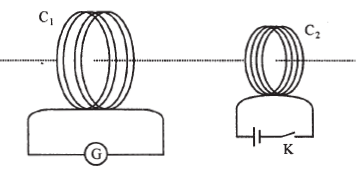
A current is induced in coil C1 due to the motion of current carrying coil C2. (a) Write any two ways by which a large deflection can be obtained in the galvanometer G. (b) Suggest an alternative device to demonstrate the induced current in place of a galvanometer.

Find the intensity at a point on a screen in Young’s double slit experiment where the interfering waves have a path difference of (i) $\lambda/6$, and (ii) $\lambda/2.$
1 F (farad) is a very large unit for practical purposes. Explain with example.
Find the wavelength of electromagnetic waves of frequency 5 × 10¹⁹Hz in free space. Give its two applications.
In a long straight wire, a current of 5 A is flowing. How much magnetic field will be produced at a distance of 10 cm from it? Which rule will give the direction of the field?
The equation $\omega=\frac{\mu_\text{v}-\mu_\text{r}}{\mu-1}$ asderived for a prism having small refracting angle. Is it also valid for a prism of large refracting angle? Is it also valid for a glass slab or a glass sphere?
The force acting on a particle moving along X-axis is F = -k(x - u0t) where k is a positive constant. An observer moving at a constant velocity v0, along the X-axis looks at the particle. What kind of motion does he find for the particle?
A and B are two conducting spheres of equal radius, in which sphere $A$ is solid and sphere $B$ is hollow. Both are charged to the same potential. What will be the relation between the charges on both the spheres?
12J of work has to be done against an existing electric field to take a charge of 0.01C from A to B. How much is the potential difference VB - VA?