Question
State the limitations of ohm's law.

Answer

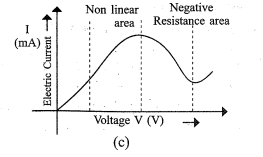
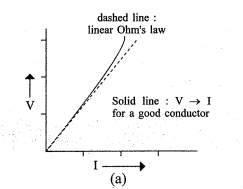
(1) In some devices V and I are not proportional to each other.

Image

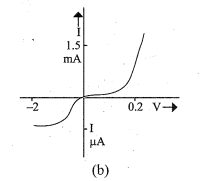
(2) The relation between V and I depends on the sign of V. In other words, if I is the current for a certain value of V , then reversing the direction of V keeping its magnitude fixed, does not produce a current of the same magnitude as I in the opposite direction. This happens in case of diode.

Image

(3) The relation between V and I is not unique means there are more than one value of V for the same current I. for example, GaAs (Gallium Arsenide).

Image

Need a full question paper?

Generate a complete, print-ready paper with questions like this in minutes — across 16+ boards, with answer keys.
Start Generating Free

Similar questions

The two wires shown in are made of the,

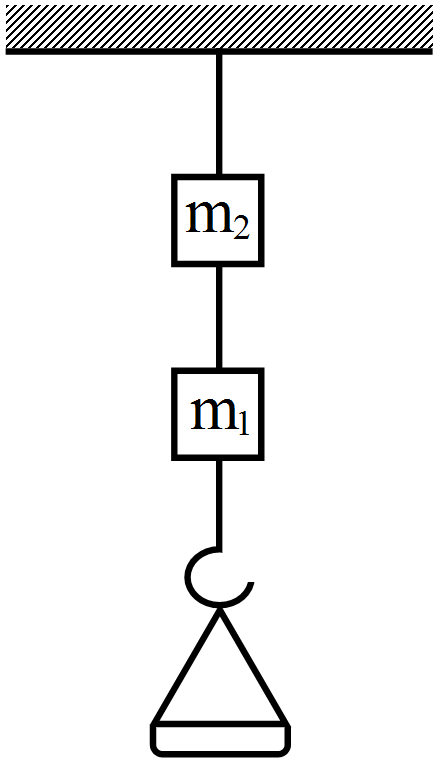
same material which has a breaking stress of $8 \times 10^8N/m^2.$ The area of cross-section of the upper wire is $0.006cm^2$ and that of the lower wire is $0.003cm^2$. The mass $m_1 = 10kg, m_2= 20kg$ and the hanger is light:
  1. Find the maximum load that can be put on the hanger without breaking a wire. Which wire will break first if the load is increased?
  2. Repeat the above part if $m_1 = 10kg$ and $m_2 = 36kg.$
Prove that, if an insulated, uncharged conductor is placed near a charged conductor and no other conductors are present, the uncharged body must be intermediate in potential between that of the charged body and that of infinity.
Prove that the current density of a metallic conductor is directly proportional to the drift speed of electrons.
The near point and the far point of a child are at 10cm and 100cm. If the retina is 2.0cm behind the eye-lens, what is the range of the power of the eye-lens?
Suppose the rod in the previous problem has a mass of 1kg distributed uniformly over its length:
  1. Find the initial angular acceleration of the rod.
  2. Find the tension in the supports to the blocks of mass 2kg and 5kg.
A converging lens and a diverging mirror are placed at a separation of 15cm. The focal length of the lens is 25cm and that of the mirror is 40cm. Where should a point source be placed between the lens and the mirror so that the light, after getting reflected by the mirror and then getting transmitted by the lens, comes out parallel to the principal axis?
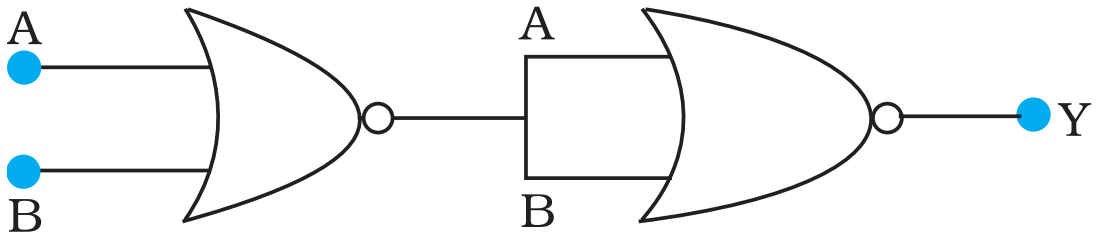
Write the truth table for circuit given in Fig. 14.47 below consisting of NOR gates and identify the logic operation (OR, AND, NOT) which this circuit is performing.
(Hint: A = 0, B = 1 then A and B inputs of second NOR gate will be 0 and hence Y=1. Similarly work out the values of Y for other combinations of A and B. Compare with the truth table of OR, AND, NOT gates and find the correct one.)
In hydrogen atom, there is single electron only but many lines in its emission spectrum. How it does? Explain the reason.
Draw a circuit diagram of a common emitter amplifier using n-p-n transistor. Derive an expression for the current gain $\beta_{ac}.$
Obtain the binding energy (in MeV) of a nitrogen nucleus $(^{14}_7\text{N})$, given m $(^{14}_7\text{N})$ = 14.010307 u