Question
State the main points of difference between homogeneous and heterogeneous mixtures.

Answer

Those mixtures in which the substances are completely mixed together and are indistinguishable from one another, are called homogeneous mixtures. They have a uniform composition throughout its mass. All the homogeneous mixtures are called solutions.
Examples: Sugar solution, salt solution, copper sulphate solution, etc.
Those mixtures in which the substances remain separate and one substance is spread throughout the other substance as small particles, droplets or bubbles, are called heterogeneous mixtures. Heterogeneous mixture does not have a uniform composition throughout its mass.
Example: Starch solution, soap solution.

Need a full question paper?

Generate a complete, print-ready paper with questions like this in minutes — across 16+ boards, with answer keys.

Start Generating Free

Similar questions

How does sound from a sound producing body travel through air to reach our ears? Illustrate your answer with the help of a labelled diagram.

Explain the various methods of crop improvement. Name one improved variety of Rice, Maize, Soybean, Sunflower and Mustard.
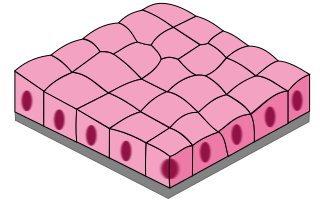
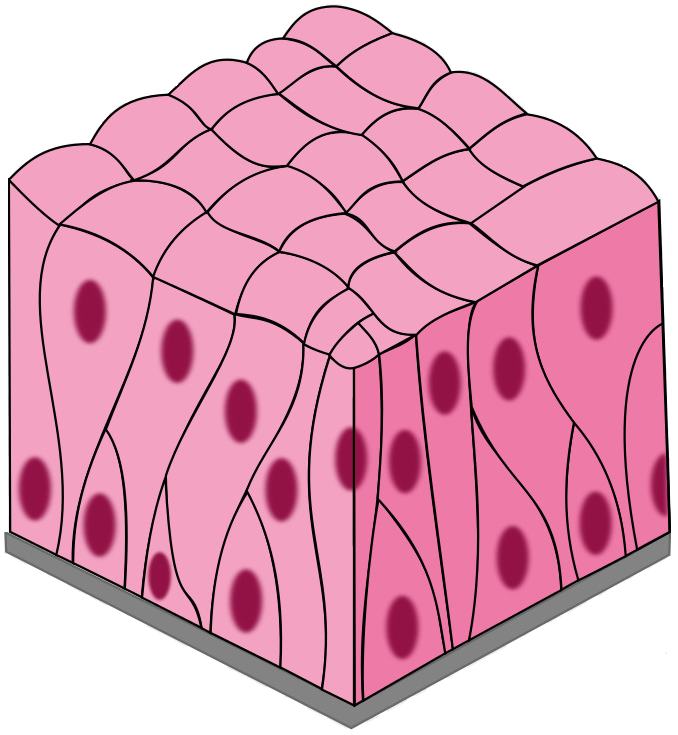
  1.  

  1.  

  1. Identify figures A and B.
  2. Which is called tesselated and payement epitheliurn?
  3. Which one lines the gastrointestinal tract and epiglottis?
  4. Which one allows diffusion of substances?
A liquid compound X of molecular mass 18u can be obtained from a number of natural sources. All the animals and plants need liquid X for their survival. When an electric current is passed through 200 grams of pure liquid X under suitable conditions, then 178 grams of gas Y and 22 grams of gas Z are produced. Gas Y is produced at the positive electrode whereas gas Z is obtained at the negative electrode. Moreover, gas Y supports combustion whereas gas Z burns itself causing explosions.
  1. Name (i) liquid X (ii) gas Y, and (iii) gas Z
  2. What is the ratio to the mass of element Z to the mass of element Y in the liquid X?
  3. Which law of chemical combination is illustrated by this example?
  4. Name two sources of liquid X.
  5. Gate an important use of Y in our life.
State and prove the law of conservation of linear momentum.
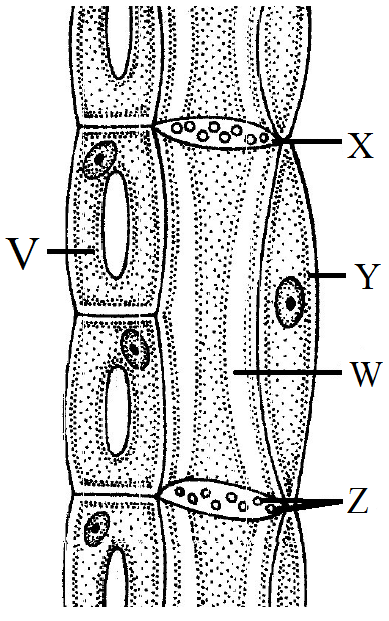
  1. Identify the figure. What is its function?
  2. Label V and W.
  3. Label X, Y and Z.
  4. W loses its nucleus in the mature state, still it remains alive. Explain how?

Describe an experiment to show that sound cannot pass through vacuum.
How is green revolution different from white revolution?
An element X forms the following compounds with hydrogen, carbon and oxygen:
H2X, CX2, XO2, XO3
How is water purified on a large scale at water works? Explain with the help of a labelled diagram. Name the substance which is added to kill germs in the drinking water supply?