Question
State the Oersted's observation.

Answer

Image

→Oersted observed that a current in a straight wire caused deflection in a nearby magnetic compass needle.
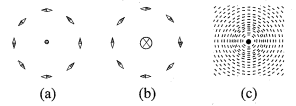
→As shown in the figure (a), the wire is perpendicular to the plane of the paper. Electric current is emerging out of the plane of the paper.
→In this condition, the alignment of the needle is tangential to an imaginary circle which has straight wire as its centre and plane perpendicular to the wire.
→Here, since the current passing through the wire is relatively large, the resulting magnetic field is relatively strong, so the Earth's magnetic field can be neglected.
→As shown in figure (b), by reversing the direction of the current (going in to the plane of paper)the orientation of the needle is also reversed.
→The deflection of needle increases on increasing the current or bringing the needle closer to the wire. it indicates that the magnetic field increases in magnitude.
→As shown in figure (c). If iron ear fillings sprinkled around the wire arrange themselves in concentric circles with the wire as the centre.
→From all of these experiments, Oersted concluded that moving charges or currents produced a magnetic field in the surrounding space.

Need a full question paper?

Generate a complete, print-ready paper with questions like this in minutes — across 16+ boards, with answer keys.

Start Generating Free

Similar questions

Find the thermo-emf developed in a copper-silver thermocouple when the junctions are kept at $0^\circ$C and $40^\circ$C. Use the data in table.
 
Metal with
a
b
lead (Pb)
$\mu\text{V}/^\circ\text{C}$
$\mu\text{V}/^\circ(\text{C})^2$
Aluminium
-0.47
0.003
Bismuth
-43.7
-0·47
Copper
2.76
0·012
Gold
2.90
0.0093
Iron
16.6
-0.030
Nickel
19.1
-0.030
Platinum
-1.79
-0.035
Silver
2.50
0.012
Steel
10.8
-0.016
 
The mass of a H-atom is less than the sum of the masses of a proton and electron. Why is this?
What should be the radius ‘r’ of nearest possible orbits of satellite of mass ‘m’ revolving around the planet of mass ‘M’ as per Bohr Postulates in terms of m, M, G, h where G is Gravitational constant and h is plank’s constant.
The refractive index of a material of a concave lens is $n_1$. It is immersed in a medium of refractive index $n_2 A$ parallel beam of light is incident on the lens. Trace the path of emergent rays when (i) $n_2=n_1$ (ii) $n_2>n_1$ (iii) $n_2<n_1$.
$\frac{1}{\text{f}}=\Big(\frac{\text{n}_1}{\text{n}_2}-1\Big)\Big(\frac{1}{\text{R}_2}-\frac{1}{\text{R}_2}\Big)$
A tuning fork of frequency 256Hz produces 4 beats per second with a wire of length 25cm vibrating in its fundamental mode. The beat frequency decreases when the length is slightly shortened. What could be the minimum length by which the wire be shortened so that it produces no beats with the tuning fork?
An electron, an alpha particle and a proton have the same kinetic energy. Which one of these particles has (i) the shortest and (ii) the largest, de Broglie wavelength?
Answer the following questions:
A steady current flows in a metallic conductor of non-uniform cross-section. Which of these quantities is constant along the conductor: current, current density, electric field, drift speed?
A transmission wire carries a current of 100A. What would be the magnetic field B at a point on the road if the wire is 8m above the road?
A voltmeter consists of a $25\Omega$ coil connected in series with a $575\Omega$ resistor. The coil takes 10mA for full scale deflection. What maximum potential difference can be measured by this voltmeter?
It is said that the separation between the two charges forming an electric dipole should be small. Small compared to what?