Question
State the preparation, properties and uses of methanol.

Answer

$\rightarrow$ Methanol$, \ce{CH3OH},$ also known as 'wood spirit', was produced by destructive distillation of wood. Today, most of the methanol is produced by catalytic hydrogenation of carbon monoxide at high pressure and temperature and in the presence of $\ce{ZnO - Cr2O3}$ catalyst.
$\ce{CO +2 H 2} \xrightarrow[\substack{200-300\ atm\ 
573-673 k }]{ \ce{ZnO - Cr2O3}CH3OH}$
$\rightarrow$ Methanol is a colourless liquid and boils at $337 K$. It is highly poisonous in nature. Ingestion of even small quantities of methanol can cause blindness and large quantities causes even death. Methanol is used as a solvent in paints, varnishes and chiefly for making formaldehyde.

Need a full question paper?

Generate a complete, print-ready paper with questions like this in minutes — across 16+ boards, with answer keys.
Start Generating Free

Similar questions

How would you account for the following? 
  1. Many of the transition elements are known to form interstitial compounds.
  2. The metallic radii of the third (5d) series of transition metals are virtually the same as those of the corresponding group members of the second (4d) series.
  3. Lanthanoids form primarily +3 ions, while the actinoids usually have higher oxidation states in their compounds, +4 or even +6 being typical.
Answer the following questions:
Give reasons:
  1. Among transition metals, the highest oxidation state is exhibited in oxoanions of a metal.
  2. $\ce{Ce^{4+}}$ is used as an oxidising agent in volumetric analysis.
  3. $\ce{Zn^{2+}}$ salts are white while $\ce{Cu^{2+}}$ salts are blue.
In the button cell widely used in watches and other devices the following reaction takes place:
$Zn(s)+Ag_2 O(s)+H_2 O(l) \rightarrow Zn^{2+}(a q)+2 Ag(s)+2 OH^{-}(a q)$
Determine $\Delta_r G^{(-)}$and $E ^{(-)}$for the reaction
Given $Z n \rightarrow Z n^{2+}+2 e^{-}, E ^0=0.76 V$
Given $Ag \rightarrow Ag ^{+}+2 e^{-}, E ^0=0.344 V$
Write down the $\text{IUPAC}$ name for the following complex and indicate the oxidation state, electronic configuration and coordination number. Also give stereochemistry and magnetic moment of the complex:
$\ce{K_4[Mn(CN)_6]}$
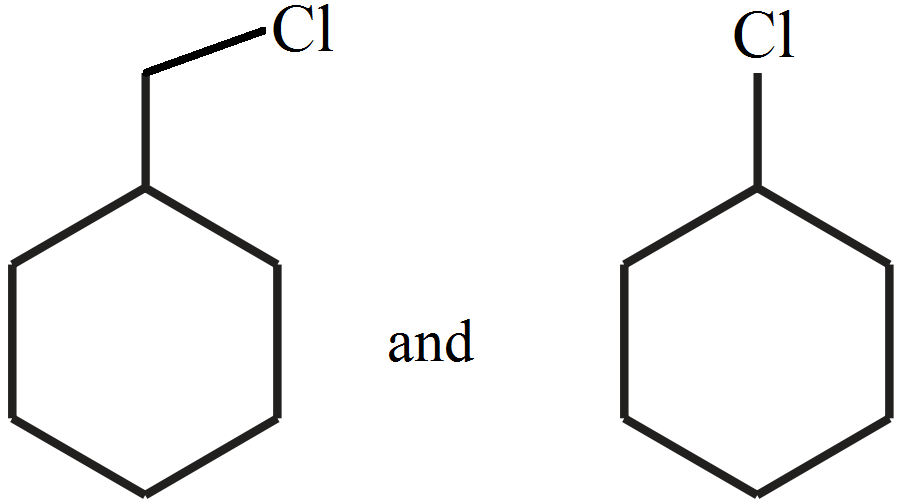
Answer the following questions: In the following pairs of halogen compounds, which would undergo $S_N1$ reaction faster? Explain.
Mention a chemical property in which methanoic acid differs from acetic acid.
Give the principle of the manufacture of nitric acid from ammonia?
Assign reasons for the following:
The transition metals and many of their compounds act as good catalysts.
Write structural formulas and names of four possible aldol condensation products from propanal and butanal in each case indicate which aldehyde acts as nucleophile and which as electrophile.
Explain Halogenation, Nitration, Sulphonation and Friedel crafts reaction of chlorobenzene.