Question
State the relation between marginal product and average product. Show this relation in a diagram.
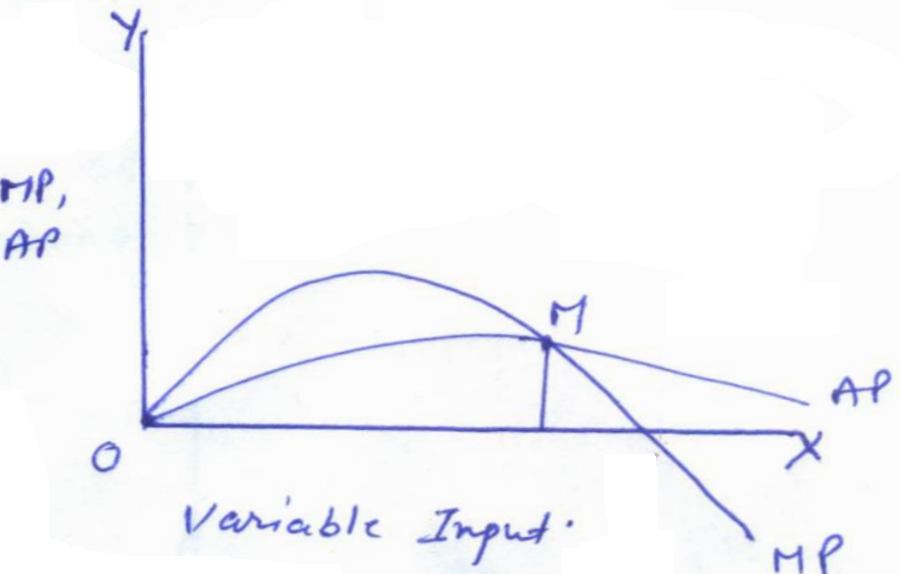
Answer


When MP > AP, AP rises i.e. between O and M.
When MP = AP, AP is constant i.e. at M.
When MP < AP, AP falls i.e. after M.

Need a full question paper?

Generate a complete, print-ready paper with questions like this in minutes — across 16+ boards, with answer keys.

Start Generating Free

Similar questions

The price of commodity is ₹15 per unit and its quantity demanded is 500 units. Its quantity demanded rises by 80 units as a result of fall in its price by 20 percent. Calculate its price elasticity of demand. Is its demand inelastic? Give reason for your answer.
A producer supplies 80 units of a good at a price of Rs. 10 per unit. Price elasticity of supply is 4. How much will he supply at Rs. 9 per unit?
Complete the following table:
Output

(Units)
Average Revenue

(Rs.)
Marginal Revenue

(Rs.)
Total Revenue

(Rs.)
1 - 15 -
2 - - 26
3 11 - -
4 - 3 -
A consumer consumes only two goods $A$ and $B$ and is in equilibrium. Show that when price of good $B$ falls, demand for $B$ rises. Answer this question with the help of utility analysis.
Explain the implications of the following features of monopolistic competition.
  1. Product differentiation.
  2. Free entry or exit of firms.
What does the Law of Variable Proportions show? State the behaviour of marginal product according to this law.
Complete the following table.
Output (Units) 1 2 3 4
AR(₹) - - 11 -
MR (₹) 15 - - 3
TR (₹) - 26 - -
PED of X is known to be thrice that of Y. If price of the commodity X increases by 20% and price of the commodity Y decreases by 40%, calculate percentage change in demand in both the cases.
Price elasticity of supply of a good is 2. A producer supplies 100 units of a good at a price of Rs. 20 per unit. At what price will he supply 80 units.
How the efficiency may increase if two firms merge?​​​​​​​