Question
State the use of galvanometer as a voltmeter.

Answer

A galvanometer can also be used as a voltmeter.

Image

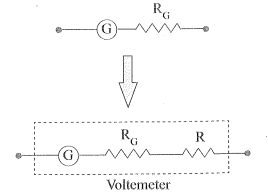
For using galvanometer as a voltmeter it is connected in parallel with that component of the circuit.
A galvanometer is a very sensitive device, so to avoid damage the current passing through it should be very small.
For this a large resistance is connected in series with galvanometer, as shown in the figure.
The resistance of voltmeter is $R _{ G }+ R$
But $R \gg R _{ G }$,
So, $R _{ G }$ can be neglected as compare to R so the resistance of the voltmeter becomes $\approx R$.

Need a full question paper?

Generate a complete, print-ready paper with questions like this in minutes — across 16+ boards, with answer keys.

Start Generating Free

Similar questions

A person is painting his house walls. He stands on a ladder with a bucket containing paint in one hand and a brush in other. Suddenly the bucket slips from his hand and falls down on the floor. If the bucket with the paint had a mass of 6.0kg and was at a height of 2.0m at the time it slipped, how much gravitational potential energy is lost together with the paint?
Why is the interference pattern not detected, when two coherent sources are far apart?
Figure. shows a cylindrical tube of cross-sectional area A fitted with two frictionless pistons. The pistons are connected to each other by a metallic wire. Initially, the temperature of the gas is $T_0$ and its pressure is P, which equals the atmospheric pressure. (a) What is the tension in the wire? (b) What will be the tension if the temperature is increased to $2T_0?$​​​​​​​
A pendulum clock giving correct time at a place where $g = 9.800m/s^2$ is taken to another place where it loses 24 seconds during 24 hours. Find the value of g at this new place.
X-ray and visible light travel at the same speed in vacuum. Do they travel at the same speed in glass?
In 1959 Lyttleton and Bondi suggested that the expansion of the Universe could be explained if matter carried a net charge. Suppose that the Universe is made up of hydrogen atoms with a number density N, which is maintained a constant. Let the charge on the proton be: $e_p= -(1 + y)e$ where e is the electronic charge.
Show that the velocity of expansion is proportional to the distance from the centre.
Two conducting spheres of radii $R_1$ and $R_2$ are kept widely separated from each other. What are their individual capacitances? If the spheres are connected by a metal wire, what will be the capacitance of the combination? Think in terms of series-parallel connections.
Two voltameters, one having a solution of silver salt and the other of a trivalent-metal salt, are connected in series and a current of 2A is maintained for 1.50 hours. It is found that 1.00g of the trivalent-metal is deposited.
  1. What is the atomic weight of the trivalent metal?
  2. How much silver is deposited during this period? Atomic weight of silver is 107.9 g/mole.
A $15.0 \mu F$ capacitor is connected to a $220 V , 50 Hz$ source. Find the capacitive reactance and the current (rms and peak) in the circuit. If the frequency is doubled, what happens to the capacitive reactance and the current?
What happens to the energy of light waves in interference?