Question
State two consequences, which one has to face while dealing with an infectious diseases?

Answer

The two consequences that a person has to face while dealing with an infectious diseases are that the body organs and functions are damaged and need a lot of care for the recovery. The second thing is that the person becomes prone to further infections and diseases and have low immunity.

Need a full question paper?

Generate a complete, print-ready paper with questions like this in minutes — across 16+ boards, with answer keys.
Start Generating Free

Similar questions

What will happen if:
  1. Ligament gets over stretched?
  2. Heparin is absent in blood.
  3. Striated muscles contract rapidly for longer duration.
Name the following:
  1. Smallest cell organelle.
  2. Largest cell organelle.
  3. ER studded with ribosomes.
  4. Functional segments of the DNA molecule.
Briefly explain depletion of ozone layer and its effects.
A gold sample contains $90\%$ of gold and the rest copper. How many atoms of gold are present in one gram of this sample of gold?
Why does a desert cooler cool better on a hot dry day?
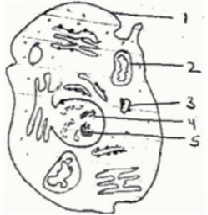
Observe the diagram of the cell below answer the following questions.
Image
i. Label the parts of the cell
ii. what function does part 1 perform?
iii. If the organelle 2 is removed from the cell, what effect is it going to make on the functions of the cell?
iv. Identify, whether it is plant cell or animal cell
v. Which structure is called 'Powerhouse of the cells'?
Both bacteria and Amoeba are single-called, yet are placed in different kingdoms. Give one reason.
In what respects does a true solution differ from a colloidal solution?
A $60\ g$ bullet fired from a $5\ kg$ gun leaves with a speed of $500\ m/s.$ Find the speed $($velocity$)$ with which the gun recoils $($jerks backwards$).$
The scientists now say that there are actually five states of matter $A, B, C, D$ and $E$. The state A has a fixed volume but no fixed shape. The state B can be compressed very easily by applying pressure and state $C$ has a fixed shape as well as a fixed volume. The state $D$ is mixture of free electrons and ions whereas state E is named after an Indian scientist and a famous physicist.
  1. Name the physical states $(i) A\ (ii) B\ (iii) C\ (iv) D$, and $(v) E$.
  2. Name one substance belonging to state $C$ which can directly change into vapours on heating. What is this process known as?
  3. Name one substance which normally belongs to state B but whose solid form changes directly into gaseous state.
  4. Name the most common substance belonging to state $A$.
  5. Which state of matter makes the sum and other stars to glow.