Question
State whether the following statements are true or false. Justify your answer.
A circle has its centre at the origin and a point P(5, 0) lies on it. The point Q(6, 8) lies outside the circle.
Answer

True:If the distance of $Q$ from the cente $O(0,0)$ is greater than the radius then point $Q$ lies in the exterior of the circle. Point $P(5,0)$ lies on thr circle and centre is at $O(0,0)$ so radius $=O P$
$\Rightarrow O P^2=\left(x_2-x_1\right)^2+\left(y_2-y_1\right)^2$
$\Rightarrow O P^2=(5-0)^2+(0-0)^2$
$\Rightarrow O P^2=5^2$
$\Rightarrow O P=5 \text { units }$
Now, $OQ ^2=(6-0)^2+(8-0)^2$
$\Rightarrow O Q^2=36+64$
$\Rightarrow O Q^2=100$
$\Rightarrow O Q=10 \text { units }$
$\Rightarrow O Q>O P \text { (radius) }$
So, point Q lies exterior to circle.

Need a full question paper?

Generate a complete, print-ready paper with questions like this in minutes — across 16+ boards, with answer keys.

Start Generating Free

Similar questions

Write 'True' or 'False' and justify your answer.
If $\cos A+\cos ^2 A=1$, then $\sin ^2 A+\sin ^4 A=1$
If the length of an arc of a circle of radius r is equal to that of an arc of a circle of radius $2r$, then the angle of the corresponding sector of the first circle is double the angle of the corresponding sector of the other circle. Is this statement false Why?
Is the area of the circle inscribed in a square of side $\text{a cm},\pi\text{a}^2\text{cm}^2?$ Give reasons for your answer.
The value of $\sin \theta+\cos \theta$ is always greater than 1 .
Two numbers have 12 as their HCF and 350 as their LCM (True/ False).
Write ‘True’ or ‘False’ and justify your answer.
$\frac{\tan47^\circ}{\cot43^\circ}=1$
Write True or False and give reasons for your answer in each of the following.
To construct a triangle similar to a given $\triangle ABC$ with its sides $\frac{7}{3}$ of the corresponding sides of $\triangle ABC$, draw a ray $B X$ making acute angle with $B C$ and $X$ lies on the opposite side of $A$ with respect to $B C$. The points $B_1, B_2, \ldots, B_7$ are located at equal distances on $B X, B_3$ is joined to $C$ and then a line segment $B_6 C^{\prime}$ is drawn parallel to $B_3 C$ where $C^{\prime}$ lies on BC produced. Finally, line segment $A ^{\prime} C ^{\prime}$ is drawn parallel to AC .
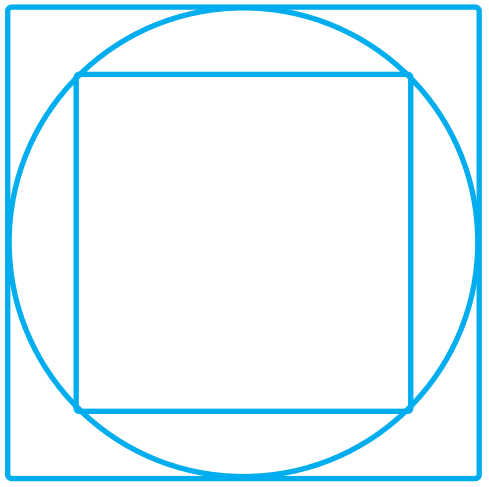
In Fig. a square is inscribed in a circle of diameter $d$ and another square is circumscribing the circle. Is the area of the outer square four times the area of the inner square? Give reasons for your answer.
Write whether the following statements are true or false. Justify your answers.
Every quadratic equation has at least one real root.
It is given that $\triangle\text{DEF}\sim\triangle\text{RPQ}.$ Is it true to say that $\angle\text{D}=\angle\text{R}\text{ and }\angle\text{F}=\angle\text{P}?$ Why?