Question
State whether the following statements are true or false. Justify your answer.
Point P(-4, 2) lies on the line segment joining the points A(-4, 6) and B(-4, -6).
Answer

True:We observe that x-coordiante is sane i.e, equal to (-4) so line is parallel to y-coordinate of P i.e., 2 lies between 6 and -6 of A and B respectively. Hence, P lies between and on AB.
Alternate Answer
Point P(-4, 2) will lie on the line AB if area of $\triangle\text{ABP}$ is Zero.
$\therefore\text{i.e., } \text{ar }\text{ABP}=0$
$\Rightarrow\frac{1}{2}\big[\text{x}_1(\text{y}_2-\text{y}_3)+\text{x}_2(\text{y}_3-\text{y}_1)+\text{x}_3(\text{y}_1-\text{y}_2)\big]$
$\Rightarrow\frac{1}{2}\big[-4(-6-2)-4(2-6)-4(6+6)\big]=0$
$\Rightarrow\big[-4(-8)-4(-4)-4(12)\big]=0$
$\Rightarrow32+16-48=0 $
$\Rightarrow48+48=0$ which is true.
Hence, point P lies on the line joining A and B.

Need a full question paper?

Generate a complete, print-ready paper with questions like this in minutes — across 16+ boards, with answer keys.

Start Generating Free

Similar questions

State whether the following statements are true or false. Justify your answer.
Point P(0, 2) is the point of intersection of y-axis and perpendicular bisector of line segment joining the points A(-1, 1) and B(3, 3).
The areas of two sectors of two different circles with equal corresponding arc lengths are equal. Is this statement true? Why?
If a quadratic polynomial f(x) is a square of a linear polynomial, then its two zeros are coincident.(True/ False).
Write ‘True’ or ‘False’ and justify your answer in the following:
Two identical solid hemispheres of equal base radius r cm are stuck together along their bases. The total surface area of the combination is $6\pi\text{r}^2.$
Is it true to say that area of a square inscribed in a circle of diameter $p \ cm$ is $p^2 \ cm^2$ ? Why?
Write ‘True’ or ‘False’ and justify your answer.
If a man standing on a platform 3 metres above the surface of a lake observes a cloud and its reflection in the lake, then the angle of elevation of the cloud is equal to the angle of depression of its reflection.
If the length of an arc of a circle of radius r is equal to that of an arc of a circle of radius 2r, then the angle of the corresponding sector of the first circle is double the angle of the corresponding sector of the other circle. Is this statement false Why?
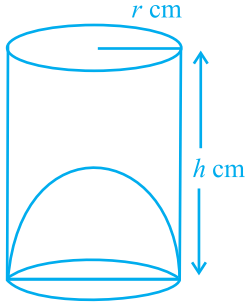
Write ‘True’ or ‘False’ and justify your answer in the following: The capacity of a cylindrical vessel with a hemispherical portion raised upward at the bottom as shown in the Fig. is $\frac{\text{r}^2}{3}3\text{h}-2\text{r}.$
Write ‘True’ or ‘False’ and justify your answer in the following:
A solid cylinder of radius r and height h is placed over other cylinder of same height and radius. The total surface area of the shape so formed is $4\pi\text{r h}+4\pi\text{r}^2.$
D is a point on side QR of $\triangle\text{PQR}$ such that $\text{PD}\perp\text{QR}$ will it be correct to say that $\triangle\text{PQD}\sim\triangle\text{RPD}?$ Why?