MCQ
Statement-1 (A): 0.7 and 0.00323232... are rational numbers.
Statement-2 (R): If the decimal expansion of a real number is either terminating or non-terminating recurring it is a rational number.
  • Statement-1 and Statement-2 are True; Statement-2 is a correct explanation for Statement-1
  • B
    Statement-1 and Statement-2 are True; Statement-2 is not a correct explanation for Statement-1.
  • C
    Statement-1 is True, Statement-2 is False.
  • D
    Statement-1 is False, Statement-2 is True.
Answer

Correct option: A.
Statement-1 and Statement-2 are True; Statement-2 is a correct explanation for Statement-1
(a)
Statement-2, being the definition of a rational number, is true. Statement-1 is also true and statement-2 is a correct explanation for statement-1. Hence, option (a) is correct

Need a full question paper?

Generate a complete, print-ready paper with questions like this in minutes — across 16+ boards, with answer keys.

Start Generating Free

Similar questions

Directions: In the following questions, the Assertions $(A)$ and Reason(s) $(R)$ have been put forward. Read both the statements carefully and choose the correct alternative from the following:
Assertion: Every polynomial equation has at least one real root.
Reason: Graph of quadratic polynomial is an ellipse.
Directions: In the following questions, the Assertions $(A)$ and Reason(s) $(R)$ have been put forward. Read both the statements carefully and choose the correct alternative from the following:
Assertion: The vertex of the triangle that is opposite is called the apex.
Reason: The angle at the apex of the triangle is called the vertex angle.
Directions: In the following questions, the Assertions $(A)$ and Reason(s) $(R)$ have been put forward. Read both the statements carefully and choose the correct alternative from the following:
Assertion: The area of a circle is the amount of flat space inside the circle’s circumference.
Reason: $\text{Area of circle}=\pi\text{r}^2.$
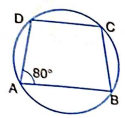
Statement-1 (A): In Fig. ABCD is a cyclic quadrilateral. If $A B \| D C$ and $\angle A=80^{\circ}$, then $\angle B=80^{\circ}, \angle C=\angle D=100^{\circ}$.
Statement-2 (R): The sum of each pair of opposite angles of a cyclic quadrilateral is $180^{\circ}$.
Image
Directions: In the following questions, the Assertions $(A)$ and Reason(s) $(R)$ have been put forward. Read both the statements carefully and choose the correct alternative from the following:
Assertion: In $\triangle\text{ABC}$ and $\triangle\text{PQR},$ $AB = PQ, AC = PR$ and $\angle\text{BAC}=\angle\text{QPR}$ $\triangle\text{ABC}\cong\triangle\text{PQR}$
Reason: Both the triangles are congruent by $SSS$ congruence.
Statement-1 (A): The graph of the linear equation $4 x+3 y=24$ mects $x$-axis at (-6,0).
Statement-2 (R): Points on $x$-axis are of the form (a, 0), where a is a variable.
Directions: In the following questions, the Assertions $(A)$ and Reason(s) $(R)$ have been put forward. Read both the statements carefully and choose the correct alternative from the following:
Assertion: $x^3 + x$ has only one real zero.
Reason: A polynomial of nth degree must have n real zeroes
Directions: In the following questions, the Assertions $(A)$ and Reason(s) $(R)$ have been put forward. Read both the statements carefully and choose the correct alternative from the following:
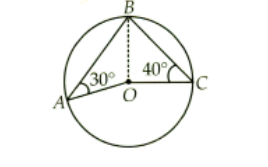
Assertion: The measure of $\angle\text{AOC}=60^\circ.$

Reason: Angle subtended by an arc of a circle at the centre of the circle is double the angle subtended by arc on the circumference.
Statement-1 (A): Every point on $y$-axis represents a solution of the equation $x=0$. Statement-2 (R): Points on $y$-axis are of the form (0, k), where k is a variable.
Directions: In the following questions, the Assertions $(A)$ and Reason(s) $(R)$ have been put forward. Read both the statements carefully and choose the correct alternative from the following:
Assertion: If $\alpha, \beta$ are the zeroes of the polynomial $x^2-16$, then $\alpha \beta(\alpha+\beta)$ is $0.$
Reason: $x^2-16=0 ~x^2=16, x=+4,-44(-4)(4-4)=-16(0)=0$.