MCQ
Statement-1 (A): A triangle with vertices at $(4,0),(-1,-1)$, and $(3,5)$ is isosceles right angled triangle.
Statement-2 (R): If $A B C$ is an isosceles triangle, then it is right angled.
  • A
    Statement- 1 is true, Statement- 2 is true; Statement- 2 is a correct explanation for Statement-1.
  • B
    Statement-1 is true, Statement-2 is true; Statement-2 is not a correct explanation for Statement-1.
  • Statement-1 is true, Statement-2 is false.
  • D
    Statement-1 is false, Statement-2 is true.
Answer

Correct option: C.
Statement-1 is true, Statement-2 is false.

Need a full question paper?

Generate a complete, print-ready paper with questions like this in minutes — across 16+ boards, with answer keys.

Start Generating Free

Similar questions

Directions : In the following questions, a statement of assertion $(A)$ is followed by a statement of reason $(R)$. Mark the correct choice as :
Assertion : The sides of two similar triangles are in the ratio $2:5,$ then the areas of these triangles are in the
ratio $4 : 25.$
Reason : The ratio of the areas of two similar triangles is equal to the square of the ratio of their sides.
Directions : In the following questions, the Assertions $(A)$ and Reason $(s)\ (R)$ have been put forward. Read both the statements carefully and choose the correct alternative from the following:
Assertion : A real no. obey associative property.
Reason : $(a + b) + c = a + (b + c)$ is a associative property.
Statement- 1(A) : If $\alpha$ and $\beta$ are the zeroes of the quadratic polynomial $k x^2+4 x+4$, where $k$ is an integer such that $(\alpha+\beta)^2-2 \alpha \beta=24$, then $k=1$.
Statement-2(R): If $\alpha$ and $\beta$ are zeroes of the polynomial $a x^2+b x+c, a \neq 0$, then $\alpha+\beta=-\frac{b}{a}$ and $\alpha \beta=\frac{c}{a}$.
Directions : In the following questions, the Assertions $(A)$ and Reason $(s) \ (R)$ have been put forward. Read both the statements carefully and choose the correct alternative from the following:
Assertion : Every irrational no is not a surd.
Reason : Surd is an irrational root of rational number.
Statement-1 (A): If $a+b+c=0$, then $a x^2+b x+c=0$ has real roots.
Statement-2 (R): If one root of a quadratic equation is real, then the other root is also real.
Directions : In the following questions, a statement of assertion $(A)$ is followed by a statement of reason $(R).$ Mark the correct choice as:
Assertion : If the circumference of two circles are in the ratio $2 : 3,$ then ratio of their areas is $4 : 9.$
Reason : The circumference of a circle of radius $r$ is $2\pi\text{r}$ and its area is $\pi\text{r}^2$
Directions : In the following questions, the Assertions $(A)$ and Reason $(s) \ (R)$ have been put forward. Read both the statements carefully and choose the correct alternative from the following:
Assertion : If $P$ and $q$ are integers and is represented in the form of $\frac{\text{p}}{\text{q}}$ then it is a ratio nal number.
Reason : $\frac{17}{3}$ is a rational number.
Statement-1 (A): 997 is the largest three digit prime number.
Statement-2 (R): A positive integer $n$ is a prime number, if no positive integer less than or equal to $\sqrt{n}$ divides $n$.
Slatement-1 (A): Let $\triangle A B C$ and $\triangle D E F$ be right triangles right angled at $B$ and $E$ respectively. If $A C=5 cm, B C=4 cm, D F=15 cm$ and $E F=12 cm$, then $\angle A=\angle D$ and $\angle C=\angle F$.
Statement-2 (R): If in two right triangles, hypotenuse and one side of one triangle are proportional to the hypotenuse and one side of the other triangle, then the triangles are similar.
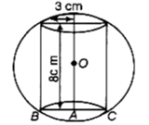
Assertion (A): In the given figure, a sphere circumscribes a right cylinder whose height is 8 cm and radius of the base is 3 cm. The ratio of the surface area of the sphere and the cylinder is 6: 11
Image
Reason (R): Ratio of their surface area $=\frac{\text { Sur face area of sphere }}{\text { Surface area of cylinder }}$