MCQ
Statement-1 (A): Everything equal to itself.
Statement-2 (R): Things which coincide with one another are equal to one another.
  • Statement-1 is true, Statement-2 is true; Statement-2 is a correct explanation for Statement-1.
  • B
    Statement-1 is true, Statement-2 is true; Statement-2 is not a correct explanation for Statement-1.
  • C
    Statement-1 is true, Statement-2 is false.
  • D
    Statement-1 is false, Statement-2 is true.
Answer

Correct option: A.
Statement-1 is true, Statement-2 is true; Statement-2 is a correct explanation for Statement-1.
a

Need a full question paper?

Generate a complete, print-ready paper with questions like this in minutes — across 16+ boards, with answer keys.

Start Generating Free

Similar questions

Directions: In the following questions, the Assertions $(A)$ and Reason(s) $(R)$ have been put forward. Read both the statements carefully and choose the correct alternative from the following:
Assertion: Boundaries of surfaces are curves.
Reason: Surfaces are dimensional figures and their boundaries are one - dimensional which curves are.
Directions: In the following questions, the Assertions $(A)$ and Reason(s) $(R)$ have been put forward. Read both the statements carefully and choose the correct alternative from the following:
Assertion: A quadratic polynomial can have at most two zero.
Reason: $x^2+7 x+9$ has two zero.
Directions: In the following questions, the Assertions $(A)$ and Reason(s) $(R)$ have been put forward. Read both the statements carefully and choose the correct alternative from the following:
Assertion: In $\triangle\text{ABC},$ $\angle\text{A}=43^\circ$ and $\angle\text{C}=70^\circ$ then the measure of $\angle\text{B}$ is $67^\circ $.
Reason: Sum of angle of triangle is $180^\circ $.
Directions: In the following questions, the Assertions $(A)$ and Reason(s) $(R)$ have been put forward. Read both the statements carefully and choose the correct alternative from the following:
Assertion: The graph of every linear equation in two variables is a straight line.
Reason: $x = 0$ is the equation of the $y$ - axis and $y = 0$ is the equation of the $x$ - axis.
Directions: In the following questions, the Assertions $(A)$ and Reason $(s) \ (R)$ have been put forward. Read both the statements carefully and choose the correct alternative from the following:
Assertion: All the diameter of the circle have the same length.
Reason: Diameter is the half of radius.
Directions: In the following questions, the Assertions $(A)$ and Reason(s) $(R)$ have been put forward. Read both the statements carefully and choose the correct alternative from the following:
Assertion: All the sides of a square are of equal length.
Reason: All squares are congruent.
Directions: In the following questions, the Assertions $(A)$ and Reason(s) $(R)$ have been put forward. Read both the statements carefully and choose the correct alternative from the following:
Assertion: One equation of a pair of dependent linear equations is $2x + 5y = 3$. The second equation will be. $-10x - 25y + 15 = 0$.
Reason: If a pair of linear equations is consistent, then the lines will be intersecting or coincident.
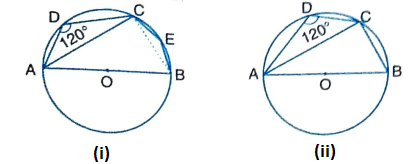
Statement-1 (A): In Fig.(i), if AOB is a diameter and $\angle A D C=120^{\circ}$, then $\angle C A B=30^{\circ}$.
Statement-2 (R): In Fig.(ii), AOB is a diameter and $\angle A D C=120^{\circ}$, then $\angle B A C=30^{\circ}$.
Image
Directions: In the following questions, the Assertions $(A)$ and Reason(s) $(R)$ have been put forward. Read both the statements carefully and choose the correct alternative from the following:
Assertion: $15$ is the mode of $4, 4, 4, 9, 15, 15, 15, 27, 37, 48$ data set.
Reason: Mode is defined as the value that has a higher frequency in a given set of values.
Directions: In the following questions, the Assertions $(A)$ and Reason(s) $(R)$ have been put forward. Read both the statements carefully and choose the correct alternative from the following:
Assertion: Two opposite angles of a parallelogram are $(3x - 2^\circ )$ and $(50 - x)^\circ .$ The measure of one of the angle is $37^\circ .$
Reason: Opposite angles of a parallelogram are equal.