MCQ
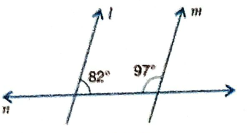
Statement-1 (A): In Fig., line lis paralld to liter m.
Statement-2 (R): If a transversal intersects two lines in such a way that a pair of consecutive interior angles are supplementary, then the two lines are parallel.
Image
  • A
    Statement-1 and Statement-2 are true; Statement-2 is a correct explanation for Statement-2
  • B
    Statement-1 and Statement-2 is true; Statement-2 is not a correct explanation for Statement-1.
  • C
    Statement-1 is true, Statement-2 is false.
  • Statement-1 is false, Statement-2 is true.
Answer

Correct option: D.
Statement-1 is false, Statement-2 is true.
(d)
Statement-2 is true.
In Fig., we find that $82^{\circ}+97^{\circ}=179^{\circ} \neq 180^{\circ}$ i.e. pair of consecutive interior angles are not supplementary. Therefore, line l is not parallel to tine m.
Thus, statement-2 is true and statement-1 is not true. Hence, option (d) is correct.

Need a full question paper?

Generate a complete, print-ready paper with questions like this in minutes — across 16+ boards, with answer keys.

Start Generating Free

Similar questions

Directions: In the following questions, the Assertions $(A)$ and Reason(s) $(R)$ have been put forward. Read both the statements carefully and choose the correct alternative from the following:
Assertion: If the pair of lines are coincident, then we say that pair of lines is consistent and it has a unique solution.
Reason: If the pair of lines are parallel, then the pairs has solution and is called inconsistent pair of equations.
Directions: In the following questions, the Assertions $(A)$ and Reason(s) $(R)$ have been put forward. Read both the statements carefully and choose the correct alternative from the following:
Assertion: $3 + 7 = 9$ is a statement.
Reason: A sentence that can be judged to be true or false, but not both, is called a statement.
Directions: In the following questions, the Assertions $(A)$ and Reason(s) $(R)$ have been put forward. Read both the statements carefully and choose the correct alternative from the following:
Assertion: Area of rhombus whose side is $20\ cm$ and one diagonal is $24\ cm$ is $38 \mathrm{~cm}^2$.
Reason: All sides of rhombus are equal.
Directions: In the following questions, the Assertions $(A)$ and Reason(s) $(R)$ have been put forward. Read both the statements carefully and choose the correct alternative from the following:
Assertion: Euclid’s fifth postulate imply the existence of parallel lines.
Reason: The sum of the interior angles will be equal to sum of the two right angles then two lines will not meet each other on either sides and therefore they will be parallel to each other.
Directions: In the following questions, the Assertions $(A)$ and Reason(s) $(R)$ have been put forward. Read both the statements carefully and choose the correct alternative from the following:
Assertion: The linear equation $2x - 5y = 7$ has no solution.
Reason: The linear equation $3x - y = x - 1$ has unique solution.
Assertion and Reason Type $\text{MCQ}$
Assertion : Every parallelogram is a rectangle.
Reason : The angle bisectors of a parallelogram form a rectangle.
Directions: In the following questions, the Assertions $(A)$ and Reason(s) $(R)$ have been put forward. Read both the statements carefully and choose the correct alternative from the following:
Assertion:

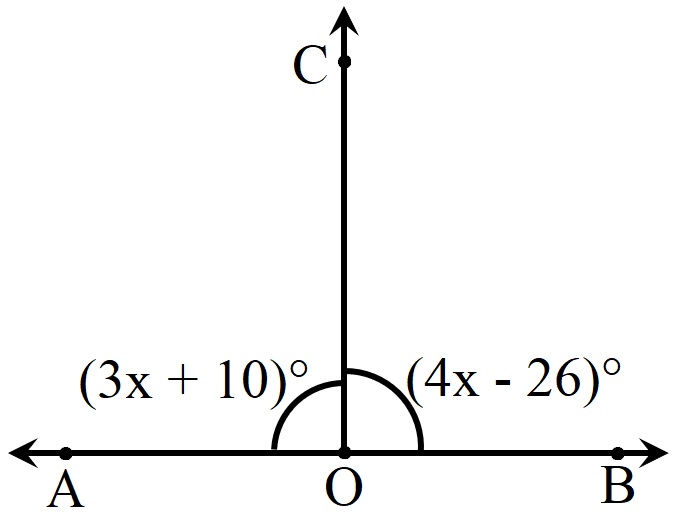
In the given figure, $AOB$ is a straight line. If
 Reason: The sum of angle that are formed on a straight line is equal to $180^\circ$.
Directions: In the following questions, the Assertions $(A)$ and Reason(s) $(R)$ have been put forward. Read both the statements carefully and choose the correct alternative from the following:
Assertion: $x = 3$ and $y = -2$ is a solution of the equation $4px – 3y = 12$, then the value of $p$ is $\frac{1}{2}$.
Reason: Graph of linear equation $ax + by + c = 0, a \times 0, 6 \times 0$ cuts $x$ - axis and $y$ - axis respectively at the points $(x, 0), (y, 0)$
Directions: In the following questions, the Assertions $(A)$ and Reason(s) $(R)$ have been put forward. Read both the statements carefully and choose the correct alternative from the following:
Assertion: $5\text{x}−2(2\text{x}−7)=2(3\text{x}−1)+\frac{7}{2}$ is $-2$.
Reason: $x + 3$ is an example of two variable expression.
Statement-1 (A): $\sqrt{2}$ is an irrational number.
Statement-2 (R): The decimal expansion of $\sqrt{2}$ is non-terminating non-recurring.