MCQ
Statement-1 (A): Let $\triangle P Q R$ be a right triangle right angled at $Q$ such that the perpendicular drawn from $Q$ on hypotenuse $P R$ meets $P R$ at $S$. If $P S=4$ cm and $R S=9 cm$, then $Q S=6 cm$.
Statement-2 (R): In a right triangle, the square of the perpendicular drawn from the vertex forming right angle to the hypotenuse is equal to the product of projections of two sides on the hypotenuse.
  • Statement-1 and Statement-2 are True; Statement-2 is a correct explanation for Statement-1.
  • B
    Statement-1 and Statement-2 are True; Statement- 2 is not a correct explanation for Statement-1.
  • C
    Statement-1 is True, Statement-2 is False.
  • D
    Statement-1 is False, Statement-2 is True.
Answer

Correct option: A.
Statement-1 and Statement-2 are True; Statement-2 is a correct explanation for Statement-1.
(A)Statement-1 and Statement-2 are True; Statement-2 is a correct explanation for Statement-1.
Image
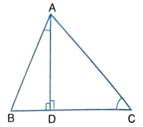
Let $A B C$ be a right triangle right angled at $A$ and $A D$ be perpendicular drawn from $A$ on hypotenuse $B C$.
In $\triangle$ 's $A D B$ and $C D A$, we have
$\angle A D B=\angle C D A$ $\qquad$ [Each equal to $90^{\circ}$ ]
and, $\quad \angle D A B=\angle D C A$
So, by using $A A$-criterion of similarity, we obtain
$
\triangle A D B \sim \triangle C D A \Rightarrow \frac{A D}{C D}=\frac{D B}{D A} \Rightarrow A D^2=B C \times C D
$
Thus, statement-2 is true. Using statement-2, we find that in $\triangle P Q R$.
$
Q S^2=P S \times R S \Rightarrow Q S^2=4 \times 9=36 \Rightarrow Q S=6 cm
$
So, statement- 1 is also true and statement- 2 is a correct explanation for statement- 1 .
Hence, option (a) is correct.

Need a full question paper?

Generate a complete, print-ready paper with questions like this in minutes — across 16+ boards, with answer keys.

Start Generating Free

Similar questions

Statement A (Assertion) : Consider the following frequency distribution:
Class interval0-44-88-1212-1616-20
Frequency6352010

The median class is 12-16.
Statement R (Reason): Let $n=\sum f_i$. Then, the class whose cumulative frequency is just lesser than $\left(\frac{n}{2}\right)$ is the median class.
Directions: In the following questions, the Assertions $(A)$ and Reason$(s) (R)$ have been put forward. Read both the statements carefully and choose the correct alternative from the following:
Assertion: The sum of the zeroes of the given quadratic polynomial $-3x^2 + k$ is $0$.
Reason: Sum of zeroes $=\frac{-\text{b}}{\text{a}}$
Directions : In the following questions, the Assertions $(A)$ and Reason $(s) \ (R)$ have been put forward. Read both the statements carefully and choose the correct alternative from the following:
Assertion : $(18, 25)$ is a pair of coprime.
Reason : Pair of coprime has common factor $2.$
Directions : In the following questions, a statement of assertion $(A)$ is followed by a statement of reason $(R).$ Mark the correct choice as:
Assertion : An event is very unlikely to happen.Its probability is $0.0001.$
Reason : If $P(A)$ denote the probability of an event $A,$ then $0\leq\text{P(A)}\leq1$
Directions : In the following questions, the Assertions $(A)$ and Reason $(s) \ (R)$ have been put forward. Read both the statements carefully and choose the correct alternative from the following :
Assertion : $3 + 0 = 0.$
Reason : $m + 0 = 0.$
Assertion(A): $(2+\sqrt{3}) \sqrt{3}$ is an irrational number.
Reason(R): Product of two irrational numbers is always irrational.
Directions : In the following questions, a statement of assertion $(A)$ is followed by a statement of reason $(R).$ Mark the correct choice as:
Assertion : If the probability of an event is $P,$ then probability of its complementary event will be $1 - P.$
Reason : When $\text{E}$ and $\overline{\text{E}}$ are complementary events, then $\text{P(E)}+\text{P}\overline{\text{E}}=1$
Directions : In the following questions, the Assertions $(A)$ and Reason $(s) \ (R)$ have been put forward. Read both the statements carefully and choose the correct alternative from the following:
Assertion : Every composite no. Can be expressed as product of primes
Reason : $11 \times 4 \times 3 \times 2 + 4$ is a composite number.
Directions: In the following questions, the Assertions $(A)$ and Reason(s) $(R)$ have been put forward. Read both the statements carefully and choose the correct alternative from the following:
Assertion: $y^2 + 6y + 9$ has two zeros.
Reason: A quadratic Polynomial can have at most two zeros.
Directions : In the following questions, the Assertions $(A)$ and Reason $(s)\ (R)$ have been put forward. Read both the statements carefully and choose the correct alternative from the following:
Assertion : $\frac{1}{22}$ can not be written as terminating decimal.
Reason : $\frac{1}{16}$ can be written as a terminating decimal.