MCQ
Statement-1 (A): $\sqrt{6+\sqrt{6+\sqrt{6+\sqrt{6+}}}} \ldots \ldots \ldots \ldots \infty=3$.
Statement-2 (R): $\sqrt{x+\sqrt{x+\sqrt{x+}}} \ldots \ldots \ldots \ldots \infty=x, x>0$.
  • A
    Statement-1 is true, Statement-2 is true; Statement-2 is a correct explanation for Statement-1.
  • B
    Statement-1 is true, Statement-2 is true; Statement-2 is not a correct explanation for Statement-1.
  • Statement-1 is true, Statement-2 is false.
  • D
    Statement-1 is false, Statement-2 is true.
Answer

Correct option: C.
Statement-1 is true, Statement-2 is false.
C

Need a full question paper?

Generate a complete, print-ready paper with questions like this in minutes — across 16+ boards, with answer keys.

Start Generating Free

Similar questions

Directions: In the following questions, the Assertions $(A)$ and Reason(s) $(R)$ have been put forward. Read both the statements carefully and choose the correct alternative from the following:
Assertion: Sum of two natural numbers is a natural number.
Reason: All whole numbers are natural numbers.
Directions: In the following questions, the Assertions $(A)$ and Reason(s) $(R)$ have been put forward. Read both the statements carefully and choose the correct alternative from the following:
Assertion: The coordinates describe the points in the plane uniquely.
Reason: In second quadrant $(x, y)$ is $(+, +)$.
Directions: In the following questions, the Assertions $(A)$ and Reason(s) $(R)$ have been put forward. Read both the statements carefully and choose the correct alternative from the following:
Assertion: The rationalize factor of $6+\sqrt7$ is $6-\sqrt7.$
Reason: $7, 8, 10,$ are the negative integers.
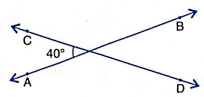
Statement-1 (A): In Fig. lines AB and CD intersect at O. IF $\angle A O C=40^{\circ}$, then $\angle B O C=140^{\circ}$
Statement-2 (R): If two lines intersect, then vertically opposite angles are equal.
Image
Directions: In the following questions, the Assertions $(A)$ and Reason(s) $(R)$ have been put forward. Read both the statements carefully and choose the correct alternative from the following:
Assertion: There can be infinite number of lines that can be drawn through a single point.
Reason: From this point we can draw only two lines.
Directions: In the following questions, the Assertions $(A)$ and Reason(s) $(R)$ have been put forward. Read both the statements carefully and choose the correct alternative from the following:
Assertion: If two lines are parallel to each other, they don’t intersect each other. They meet each other at infinity.
Reason: Two parallel lines intersect at One point.
Assertion (A): 0.271 is a terminating decimal and we can express this number as $\frac{271}{1000}$ which is of the form $\frac{p}{q}$, where p and q are integers and $q \neq 0$.
Reason (R): A terminating or non-terminating decimal expansion can be expressed as rational number.
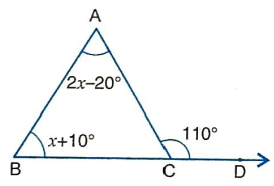
Statement-1 (A): In Fig., side BC of $\triangle A B C$ is produced to D. If $\angle A C D=110^{\circ}$, then $x=40^{\circ}$.
Statement-2 (R): If a side of a triangle is produced, the exterior angle so formed is equal to the sum of the two interior opposite angles.
Image
Directions: In the following questions, the Assertions $(A)$ and Reason(s) $(R)$ have been put forward. Read both the statements carefully and choose the correct alternative from the following:
Assertion: The points $(-3, 5)$ and $(5,-3)$ are at different positions in the coordinate plane.
Reason: If $\text{x}\neq\text{y},$ then $(\text{x},\text{y})\neq(\text{y},\text{x}).$
Directions: In the following questions, the Assertions $(A) $and Reason(s) $(R)$ have been put forward. Read both the statements carefully and choose the correct alternative from the following:
Assertion: $13, 13, 13, 13, 14, 14, 16, 18, 21$ here range is $8$
Reason: $1, 2, 4, 7$ here range is $6$