$STATEMENT-1$: Aniline on reaction with $\mathrm{NaNO}_2 / \mathrm{HCl}$ at $0^{\circ} \mathrm{C}$ followed by coupling with $\beta$-naphthol gives a dark blue coloured precipitate. and
$STATEMENT-2$: The colour of the compound formed in the reaction of aniline with $\mathrm{NaNO}_2 / \mathrm{HCl}$ at $0^{\circ} \mathrm{C}$ followed by coupling with $\beta$-naphthol is due to the extended conjugation.
IIT 2008, Advanced


Download our appand get started for free
Experience the future of education. Simply download our apps or reach out to us for more information. Let's shape the future of learning together!No signup needed.*
Similar Questions
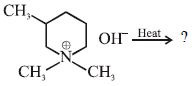
- 1View SolutionWhat is the major alkene formed in the following hofmann elimination
- 2Identify the product $Z$ in the seriesView Solution
$C{H_3}CN\xrightarrow{{Na + {C_2}{H_5}OH}}X\xrightarrow{{HN{O_2}}}Y\mathop {\xrightarrow{{{K_2}C{r_2}{O_7}}}}\limits_{{H_2}S{O_4}} Z$
- 3View SolutionThe product formed from the following reaction sequence is ?

- 4$\begin{array}{*{20}{c}}View Solution
{{\mkern 1mu} {\mkern 1mu} {\mkern 1mu} {\mkern 1mu} {\mkern 1mu} {\mkern 1mu} {\mkern 1mu} {\mkern 1mu} {\mkern 1mu} {\mkern 1mu} {\mkern 1mu} {\mkern 1mu} {\mkern 1mu} {\mkern 1mu} {\mkern 1mu} {\mkern 1mu} {\mkern 1mu} {\mkern 1mu} {\mkern 1mu} {\mkern 1mu} {\mkern 1mu} {\mkern 1mu} {\mkern 1mu} {\mkern 1mu} {\mkern 1mu} {\mkern 1mu} {\mkern 1mu} \,\,\,\,\,\,\,\,\,\,\,\,\,\,\,\,\,\,\,\,\,\,\,\,\,\,\,\,\,\,O{\mkern 1mu} {\mkern 1mu} {\mkern 1mu} {\mkern 1mu} {\mkern 1mu} {\mkern 1mu} {\mkern 1mu} {\mkern 1mu} {\mkern 1mu} {\mkern 1mu} {\mkern 1mu} {\mkern 1mu} {\mkern 1mu} {\mkern 1mu} {\mkern 1mu} {\mkern 1mu} {\mkern 1mu} {\mkern 1mu} {\mkern 1mu} {\mkern 1mu} {\mkern 1mu} {\mkern 1mu} {\mkern 1mu} {\mkern 1mu} {\mkern 1mu} {\mkern 1mu} {\mkern 1mu} {\mkern 1mu} {\mkern 1mu} {\mkern 1mu} {\mkern 1mu} {\mkern 1mu} {\mkern 1mu} {\mkern 1mu} {\mkern 1mu} {\mkern 1mu} {\mkern 1mu} {\mkern 1mu} {\mkern 1mu} {\mkern 1mu} {\mkern 1mu} {\mkern 1mu} {\mkern 1mu} {\mkern 1mu} {\mkern 1mu} {\mkern 1mu} {\mkern 1mu} {\mkern 1mu} {\mkern 1mu} {\mkern 1mu} {\mkern 1mu} {\mkern 1mu} {\mkern 1mu} {\mkern 1mu} {\mkern 1mu} {\mkern 1mu} {\mkern 1mu} {\mkern 1mu} {\mkern 1mu} {\mkern 1mu} {\mkern 1mu} {\mkern 1mu} {\mkern 1mu} {\mkern 1mu} {\mkern 1mu} {\mkern 1mu} {\mkern 1mu} {\mkern 1mu} } \\
{{\mkern 1mu} {\mkern 1mu} {\mkern 1mu} {\mkern 1mu} {\mkern 1mu} {\mkern 1mu} {\mkern 1mu} {\mkern 1mu} {\mkern 1mu} {\mkern 1mu} {\mkern 1mu} {\mkern 1mu} {\mkern 1mu} {\mkern 1mu} {\mkern 1mu} {\mkern 1mu} {\mkern 1mu} {\mkern 1mu} {\mkern 1mu} {\mkern 1mu} {\mkern 1mu} \,\,\,\,\,\,\,\,\,\,\,\,\,\,\,\,\,\,\,\,\,\,\,\,\,\,\,\,\,\,\,{\mkern 1mu} ||{\mkern 1mu} {\mkern 1mu} {\mkern 1mu} {\mkern 1mu} {\mkern 1mu} {\mkern 1mu} {\mkern 1mu} {\mkern 1mu} {\mkern 1mu} {\mkern 1mu} {\mkern 1mu} {\mkern 1mu} {\mkern 1mu} {\mkern 1mu} {\mkern 1mu} {\mkern 1mu} {\mkern 1mu} {\mkern 1mu} {\mkern 1mu} {\mkern 1mu} {\mkern 1mu} {\mkern 1mu} {\mkern 1mu} {\mkern 1mu} {\mkern 1mu} {\mkern 1mu} {\mkern 1mu} {\mkern 1mu} {\mkern 1mu} {\mkern 1mu} {\mkern 1mu} {\mkern 1mu} {\mkern 1mu} {\mkern 1mu} {\mkern 1mu} {\mkern 1mu} {\mkern 1mu} {\mkern 1mu} {\mkern 1mu} {\mkern 1mu} {\mkern 1mu} {\mkern 1mu} {\mkern 1mu} {\mkern 1mu} {\mkern 1mu} {\mkern 1mu} {\mkern 1mu} {\mkern 1mu} {\mkern 1mu} {\mkern 1mu} {\mkern 1mu} {\mkern 1mu} {\mkern 1mu} {\mkern 1mu} {\mkern 1mu} {\mkern 1mu} {\mkern 1mu} {\mkern 1mu} {\mkern 1mu} {\mkern 1mu} {\mkern 1mu} {\mkern 1mu} {\mkern 1mu} {\mkern 1mu} } \\
{C{H_3} - C{H_2} - C - N{H_2}}
\end{array}$ ${\xrightarrow[{KOH(aq)}]{{B{r_2}}}X\xrightarrow{{\begin{array}{*{20}{c}}
{\,\,\,\,O} \\
{\,\,\,\,||} \\
{{C_6}{H_5} - C - Cl}
\end{array}}}Y}$Which statement is true
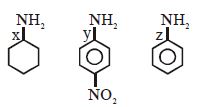
- 5Order of bond length of bond $x, y, z$View Solution
- 6$A $ will beView Solution

- 7View SolutionProduct of this reaction is

- 8View SolutionWhich of following is correct ?
- 9A trinitro compound, $1, 3,5$ tris-($4$-nitrophenyl) benzene, on complete reaction with an excess of $\mathrm{Sn} / \mathrm{HCl}$ gives major product, which on treatment with an excess of $NaNO_2 / HCl$ at $0^{\circ} C$ provides $P$ as the product. $P$, upon treatment with excess of $H_2 O$ at room temperature, gives the product $Q$. Bromination of $Q$ in aqueous medium furnishes the product $R$. The compound $P$ upon treatment with an excess of phenol under basic conditions gives the product $S$.View Solution
The molar mass difference between compounds $Q$ and $R$ is $474 \mathrm{~mol}^{-1}$ and between compounds $P$ and $S$ is $172.5 \mathrm{~g} \mathrm{~mol}^{-1}$.
($1$)The number of heteroatoms present in one molecule of $R$ is. . . . . .
[Use: Molar mass (in g mol ${ }^{-1}$ ): $\mathrm{H}=1, \mathrm{C}=12, \mathrm{~N}=14, \mathrm{O}=16, \mathrm{Br}=80, \mathrm{Cl}=35.5$
Atoms other than $\mathrm{C}$ and $\mathrm{H}$ are considered as heteroatoms]
($2$)The total number of carbon atoms and heteroatoms present in one molecule of $S$. . . . . .
[Use: Molar mass in $\mathrm{g} \mathrm{mol}^{-1}$ ]: $\mathrm{H}=1, \mathrm{C}=12, \mathrm{~N}=14, \mathrm{O}=16, \mathrm{Br}=80, \mathrm{Cl}=35.5$
Atoms other than $\mathrm{C}$ and $\mathrm{H}$ are considered as heteroatoms
Give the answer quetion ($1$) and ($2$)
- 10View SolutionLassaigne's test for nitrogen is negative for which compound ?