MCQ
Statement $-1$: Two particles moving in the same direction do not lose all their energy in a completely inelastic collision.
Statement $-2$ : Principle of conservation of momentum holds true for all kinds of collisions.
  • A
    Statement $-1$ is true, Statement $-2$ is false
  • Statement $-1$ is true, Statement $-2$ is true ;

    Statement $-2$ is the correct explanation of Statement $-1$

  • C
    Statement $-1$ is true, Statement $-2$ is true ;

    Statement $-2$ is not the correct explanation of Statement $-1$

  • D
    Statement $-1$ is false, Statement $-2$ is true
Answer

Correct option: B.
Statement $-1$ is true, Statement $-2$ is true ;

Statement $-2$ is the correct explanation of Statement $-1$

b
In completely inelastic collision, all energy is not lost(so,  tatement $-1$ is true) and the principle of conservation of momentum holds good for all kinds of collisions (so, statement $-2$ is true) . Statement $-2$ explains statement $-1$ correctly because applying the principle of conservation of momentum, we can get the common velocity and hence the kinetic energy of the combined body. 

Need a full question paper?

Generate a complete, print-ready paper with questions like this in minutes — across 16+ boards, with answer keys.

Start Generating Free

Similar questions

A cricket ball is thrown by a player at a speed of $20\,m / s$ in a direction $30^{\circ}$ above the horizontal. The maximum height attained by the ball during its motion is $........\,m$ $\left( g =10\,m / s ^2\right)$
To maintain a speed of $80\,km / h$ by a bus of mass $500\,kg$ on a plane rough road for $4\,km$ distance, the work done by the engine of the bus will be $........\,kJ$. [The coefficient of friction between tyre of bus and road is $0.04]$.
Pick the correct statements:
A ball of mass $ m$  moving with velocity $V$, makes a head on elastic collision with a ball of the same mass moving with velocity $2V$ towards it. Taking direction of $V$ as positive velocities of the two balls after collision are
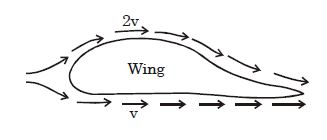
The flow speeds of air on the lower and upper surfaces of the wing of an aeroplane are $v$ and $2v$ respectively. The density of air is $\rho $ and surface area of wing is $A$ . The dynamic lift on the wing is 
One mole of an ideal gas $(\gamma  = 1.4)$ is adiabatically compressed so that its temperature rises from $27\,^oC$ to $35\,^oC$. The change in the internal energy of the gas is  .... $J$ (given $R = 8.3 \,J/mole/K$)
The two interfering waves have intensities in the ratio $9 : 4$. The ratio of intensities of maxima and minima in the interference pattern will be
The angular speed of a fly-wheel making $120\, revolution/minute$ is
One kilogram of ice at $0°C$ is mixed with one kilogram of water at $80°C.$ The final temperature of the mixture is........ $^oC$

$($Take : specific heat of water$ = 4200\,J\,k{g^{ - 1}}\,{K^{ - 1}}$, latent heat of ice $ = 336\,kJ\,k{g^{ - 1}})$

Two identical beakers $A$ and $B$ contain equal volumes of two different liquids at $60\,^oC$ each and left to cool down. Liquid in $A$ has density of $8 \times10^2\, kg / m^3$ and specific heat of $2000\, Jkg^{-1}\,K^{-1}$ while liquid in $B$ has density of $10^3\,kgm^{-3}$ and specific heat of $4000\,JKg^{-1}\,K^{-1}$ . Which of the following best describes their temperature versus time graph schematically? (assume the emissivity of both the beakers to be the same)