MCQ
Statement $A ($Assertion$) : 4 x+3 y=12$ is a line which is parallel to $8 x+6 y=48$.
Statement $R ($Reason$)$: The graph of linear equation $a x=b$, where $a \neq 0$ is parallel to $x$-axis.
  • A
    $(a)$ Both assertion $(A)$ and reason $(R)$ are true and reason $(R)$ is the correct explanation of assertion $(A)$.
  • B
    Both assertion $(A)$ and reason $(R)$ are true and reason $(R)$ is not the correct explanation of assertion $(A).$
  • Assertion $(A)$ is true but reason $(R)$ is false.
  • D
    Assertion $(A)$ is false but reason $(R)$ is true.
Answer

Correct option: C.
Assertion $(A)$ is true but reason $(R)$ is false.
The given system of linear equations is
$4 x+3 y=12\ldots(i)$
$8 x+6 y=48\ldots(ii)$
As $\frac{4}{8}=\frac{3}{6} \neq \frac{12}{48}$
Hence, the given lines are parallel to each other.
Now, $a x=b $
$\Rightarrow x=\frac{b}{a}$, which represents a line parallel to $y-$axis.
So, Assertion is true but Reason is false.

Need a full question paper?

Generate a complete, print-ready paper with questions like this in minutes — across 16+ boards, with answer keys.

Start Generating Free

Similar questions

Directions : In the following questions, the Assertions $(A)$ and Reason $ (s) \ (R)$ have been put forward. Read both the statements carefully and choose the correct alternative from the following :
Assertion : $(2-\sqrt{3}) $ is one zero of the quadratic polynomial then other zero will be $(2+\sqrt{3}).$
Reason : Irrational zeros $($roots$)$ always occurs in pairs.
Assertion (A) : The point which divides the line segment joining the points $A (1,2)$ and $B (-1,1)$ internally in the ratio $1: 2$ is $\left(\frac{-1}{3}, \frac{5}{3}\right)$
Reason (R) : The coordinates of the point which divides the line segment joining the points $A \left(x_1, y_1\right)$ and $B \left(x_2, y_2\right)$ in the ratio $m _1: m _2$ are
$
\left(\frac{m_1 x_2+m_2 x_1}{m_1+m_2}, \frac{m_1 y_2+m_2 y_1}{m_1+m_2}\right)
$
Directions : In the following questions, a statement of assertion $(A)$ is followed by a statement of reason $(R).$ Mark the correct choice as:
Assertion : The distance of a points $P(x, y)$ from the origin is $\sqrt{\text{x}^{2}-\text{y}^{2}}.$
Reason: If $P (-1, 1)$ is the mid $-$ point of the line segment joining $A \ (-3, b)$ and $B(1, b + 4),$ then value of b is $-1.$
Directions : In the following questions, the Assertions $(A)$ and Reason $(s) \ (R)$ have been put forward. Read both the statements carefully and choose the correct alternative from the following :
Assertion : $0$ is additive identity.
Reason : $\frac{1}{2}+0=\frac{1}{2}.$
Directions : In the following questions, the Assertions $(A)$ and Reason $(s)\ (R)$ have been put forward. Read both the statements carefully and choose the correct alternative from the following:
Assertion : If $a, b, c$ are in $A.P.,$ then $\frac{1}{\text{bc}},\frac{1}{\text{ac}},\frac{1}{\text{ab}}$ are also in $A.P.$
Reason : If a constant is added to each term of an $A.P.,$ then the resulting pattern of numbers is also an $A.P.$
Directions : In the following questions, a statement of assertion $(A)$ is followed by a statement of reason $(R).$ Mark the correct choice as:
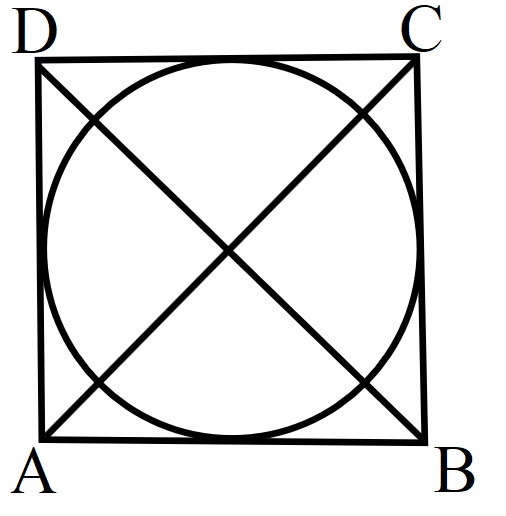
Assertion : In the given figure, all the sides of a quadrilateral $\text{ABCD}$ touch a circle with centre $O.$ Then, $\angle\text{AOB}+\angle\text{COD}=180^\circ$
Reason : The opposite sides of a quadrilateral circumscribing a circle does not subtend supplementary angles at the centre of the circle.
Assertion (A): The constant difference between any two terms of an AP is commonly known as common difference.
Reason (R): The common difference of 2, 4, 6, 8 this A.P. is 2.
Statement-1 (A) : The value of the product $P_1=\cos 1^{\circ} \cos 2^{\circ} \cos 3^{\circ} \ldots \cos 179^{\circ} \cos 180^{\circ}$ is zero.
Statement-2 (R) : The value of the product $P_2=\tan 1^{\circ} \tan 2^{\circ} \ldots \tan 89^{\circ}$ is 1 .
Directions: In the following questions, the Assertions $(A)$ and Reason $(s)\ (R)$ have been put forward. Read both the statements carefully and choose the correct alternative from the following:
Assertion: The value of $k$ for which the system of equations $3 x + ky =0,2 x - y =0$ has a unique solution is $k \neq-\frac{3}{2}$.
Reason: The system of linear equations $a_1 x+b_1 y+c_1=0$ and $a_2 x+b_2 y+c_2=0$ has a unique solution if $\frac{a_1}{a_2} \neq \frac{b_1}{b_2}$
Directions : In the following questions, a statement of assertion $(A)$ is followed by a statement of reason $(R).$ Mark the correct choice as :
Assertion : Consider the following frequency distribution :
Class interval $3-6$ $6-9$ $9-12$ $12-15$ $15-18$ $18-21$
Frequency $2$ $5$ $21$ $23$ $10$ $12$
he mode of the above data is $12.4.$
Reason : The value of the variable which occurs most often is the mode.