MCQ
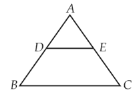
Statement $A ($Assertion$)$ : In a $\triangle \text{ABC}$, if $\ce{DE \| BC}$ and intersects $AB$ at $D$ and $AC$ at $E$, then $\frac{AB}{AD}=\frac{AC}{AE}$.
Statement $R ($Reason$)$ : If a line is drawn parallel to one side of a triangle to intersect the other two sides in distinct points, then these sides are divided in the same ratio.
  • Both assertion $(A)$ and reason $(R)$ are true and reason $(R)$ is the correct explanation of assertion $(A)$.
  • B
    Both assertion $(A)$ and reason $(R)$ are true and reason $(R)$ is not the correct explanation of assertion $(A).$
  • C
    Assertion $(A)$ is true but reason $(R)$ is false.
  • D
    Assertion $(A)$ is false but reason $(R)$ is true.
Answer

Correct option: A.
Both assertion $(A)$ and reason $(R)$ are true and reason $(R)$ is the correct explanation of assertion $(A)$.
Clearly, Reason is true as it is Thales theorem.
Image
Since, $\ce{DE \| BC}$, by Thales theorem, we have
$\frac{AD}{DB}=\frac{AE}{EC}$
$\Rightarrow \frac{DB}{AD}=\frac{EC}{AE}$
$\Rightarrow 1+\frac{DB}{AD}=1+\frac{EC}{AE}$
$\Rightarrow \frac{AD+DB}{AD}=\frac{AE+EC}{AE}$
$\Rightarrow \frac{AB}{AD}=\frac{AC}{AE},$ which is true. 
$\therefore$ Assertion and Reason both are true and Reason is the correct explanation of Assertion.

Need a full question paper?

Generate a complete, print-ready paper with questions like this in minutes — across 16+ boards, with answer keys.

Start Generating Free

Similar questions

Directions : In the following questions, the Assertions $(A)$ and Reason $(s)\ (R)$ have been put forward. Read both the statements carefully and choose the correct alternative from the following:
Assertion : If the pair of lines are coincident, then we say that pair of lines is consistent and it has a unique solution.
Reason : If the pair of lines are parallel, then the pair has no solution and is called inconsistent pair of equations.
Assertion(A): $(2+\sqrt{3}) \sqrt{3}$ is an irrational number.
Reason(R): Product of two irrational numbers is always irrational.
Directions : In the following questions, the Assertions $(A)$ and Reason $(s) \ (R)$ have been put forward. Read both the statements carefully and choose the correct alternative from the following:
Assertion : $m(n + r) = mn + nr.$
Reason :$ 5 \times (2 + 3) = 5 \times 2 + 5 \times 3$ here both side will get $25.$
Directions : In the following questions, a statement of assertion $(A)$ is followed by a statement of reason $(R)$. Mark the correct choice as :
Assertion $(A)$ : The point $(0, 4)$ lies on $y-$ axis.
Reason $(R)$ : The $x-$ coordinate on the point on $y-$ axis is zero.
Directions : In the following questions, the Assertions $(A)$ and Reason $(s)\ (R)$ have been put forward. Read both the statements carefully and choose the correct alternative from the following:
Assertion : The polynomial $\text{p}(\text{x})=\frac{3}{2}\text{x}-\frac{10}{7}$ is a linear polynomial.
Reason : The general form of linear polynomial is $ax + b.$
Statement A (Assertion) : The sum of areas of a major sector and the corresponding minor sector of a circle is equal to the area of the circle.
Statement R (Reason) : Area of the major segment of a circle $=$ Area of circle + Area of minor segment.
Directions: In the following questions, the Assertions $(A)$ and Reason $(s)\ (R)$ have been put forward. Read both the statements carefully and choose the correct alternative from the following:
Assertion: The value of $k$ for which the system of equations $3 x + ky =0,2 x - y =0$ has a unique solution is $k \neq-\frac{3}{2}$.
Reason: The system of linear equations $a_1 x+b_1 y+c_1=0$ and $a_2 x+b_2 y+c_2=0$ has a unique solution if $\frac{a_1}{a_2} \neq \frac{b_1}{b_2}$
Assertion (A): Sum of first $n$ terms in an A.P. is given by the formula: $S_n=2 n \times[2 a+(n-1) d]$
Reason (R): Sum of first 15 terms of $2,5,8 \ldots$ is 345 .
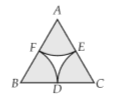
Statement A (Assertion) : In the given figure, if arcs are drawn by taking vertices $A$, $B$ and $C$ of an equilateral triangle of side $8 cm$, to intersect the sides $B C, C A$ and $A B$ at their respective mid-points $D, E$ and $F$, then area of the shaded region is $25.12 cm ^2$. (Use $\pi=3.14$ )
Image
Statement R (Reason) : The area of a sector of a circle of radius $r$ with sector angle $\theta$ is $\frac{\theta}{180^{\circ}} \times \pi r^2$ sq. units.
Assertion (A): Common difference of the AP -5, -1, 3, 7, ... is 4.
Reason (R): Common difference of the AP a, a + d, a + 2d, ... is given by d = 2nd term - 1st term.