MCQ
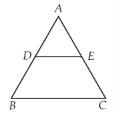
Statement $A ($Assertion$)$ : In $\triangle \ce{ABC, DE\| BC}$ and $\ce{DE: BC}=2: 5$ if $\text{AD}=6 \ cm$, then $\text{BD}=15 \ cm$.
Statement $R ($Reason$):$ In $\triangle \text{ABC}$, if $\ce{DE \| BC}$, then $\text{DE}$ divides the sides $\text{AB}$ and $\text{AC}$ in the same ratio.
  • A
    Both assertion $(A)$ and reason $( R )$ are true and reason $(R)$ is the correct explanation of assertion $(A).$
  • B
    Both assertion $(A)$ and reason $(R)$ are true and reason $(R)$ is not the correct explanation of assertion $(A).$
  • C
    Assertion $(A)$ is true but reason $(R)$ is false.
  • Assertion $(A)$ is false but reason $(R)$ is true.
Answer

Correct option: D.
Assertion $(A)$ is false but reason $(R)$ is true.
Image
By Thales theorem, $\frac{A D}{D B}=\frac{A E}{E C}$
$\Rightarrow \frac{A D}{A B}=\frac{D E}{B C}=\frac{A E}{A C}[\because \triangle \text{ADE} \sim \triangle \text{ABC}]$
$\Rightarrow \frac{2}{5}=\frac{6}{A B}\left[\because \frac{D E}{B C}=\frac{2}{5}, A D=6 \ cm \right]$
$\Rightarrow A B=\frac{5 \times 6}{2}=15$
$\therefore \text{BD=AB-AD}=15-6=9 \ cm $

Need a full question paper?

Generate a complete, print-ready paper with questions like this in minutes — across 16+ boards, with answer keys.

Start Generating Free

Similar questions

Statement-1 (A): If the angles of elevation of the top of a tower from the points at distances of 9 m and 16 m from the base of $a$ tower in the same line are complementary, then the height of the tower is 12 m .
Statement-2 (R): If the angle of elevation of a tower from two points at distances of $a$ and $b$ from its foot and in the same straight line with it are complementary, then the height of the tower is $\sqrt{a b}$.
Directions : In the following questions, the Assertions $(A)$ and Reason $(s) \ (R)$ have been put forward. Read both the statements carefully and choose the correct alternative from the following:
Assertion : The point $(0, 4)$ lies on the graph of the linear equation $4x + 4y = 16$
Reason : $(0, 4)$ satisfies the equation $4x + 4y = 16.$
Directions : In the following questions, the Assertions $(A)$ and Reason $(s) \ (R)$ have been put forward. Read both the statements carefully and choose the correct alternative from the following:
Assertion : $3x - 4y = 7$ and $6x - 8y = k$ have infinite number of solution if $k = 14.$
Reason : $a_1x + b_1y + c_1 = 0$ and $a_2x + b_2y + c_2 = 0$ have a unique solution if $\frac{\text{a}_1}{\text{}a_2}\neq \frac{\text{b}_1}{\text{b}_2}$
Directions : In the following questions, the Assertions $(A)$ and Reason $(s) \ (R)$ have been put forward. Read both the statements carefully and choose the correct alternative from the following:
Assertion : Every irrational no is not a surd.
Reason : Surd is an irrational root of rational number.
Directions : In the following questions, the Assertions $(A)$ and Reason $(s) \ (R)$ have been put forward. Read both the statements carefully and choose the correct alternative from the following:
Assertion :$ (7 \times 13 \times 11) + 11 (7 \times 6 \times 5 \times 4 \times 3 \times 2 \times 1) + 3$ have exactly composite no.
Reason : $(3 \times 12 \times 101) + 4$ is not a composite no.
Assertion (A): Common difference of the AP -5, -1, 3, 7, ... is 4.
Reason (R): Common difference of the AP a, a + d, a + 2d, ... is given by d = 2nd term - 1st term.
Directions : In the following questions, a statement of assertion $(A)$ is followed by a statement of reason $(R).$ Mark the correct choice as:
Assertion : Three points $A, B,C$ are such that $AB + BC > AC,$ then they are collinear.
Reason : Three points are collinear if they lie on a straight line.
Assertion (A) : In a cricket match, a batsman hits a boundary 9 times out of 45 balls he plays. The probability that in a given ball, he does not hit the boundary is $\frac{4}{5}$.
Reason (R) : P(E) $+P($ not $E)=1$
Statement A (Assertion) : If the first term of an A.P. is 4, last term is 81 and the sum of the given terms is 510. Then, there are 12 terms in the given A.P.
Statement R (Reason) : If $a$ is the first term, $l$ is the last term and $n$ is the number of terms of an A.P., then $S_n=\frac{n}{2}(a-l)$.
Statement $A\ ($Assertion$)$ :
$\frac{1}{(x-1)(x-2)}+\frac{1}{(x-2)(x-3)}=\frac{2}{3}(x \neq 1,2,3)$ is a quadratic equation.
Statement $R\ ($Reason$)$ : An equation of the form $a x^2+b x+c=0$, where $a, b, c \in R$ is a quadratic equation.