MCQ
Stationary waves are produced in $10\,m$  long stretched string. If the string Vibrates in $5$ segments and wave velocity  $20\,m/s$ the frequency is ..... $Hz$
  • A
    $10$
  • $5$
  • C
    $4$
  • D
    $2$

Answer

Correct option: B.
$5$
b
${n_p}\, = \,\frac{{pV}}{{2l}}\, = \,\frac{{5 \times 20}}{{2 \times 10}}\,\, = 5{\mkern 1mu} {\mkern 1mu} Hz$

Need a full question paper?

Generate a complete, print-ready paper with questions like this in minutes — across 16+ boards, with answer keys.

Start Generating Free

Similar questions

The solar spectrum during a complete solar eclipse is
The total energy of a black body radiation source is collected for five minutes and used to heat water. The temperature of the water increases from $10.0^{\circ} C$ to $11.0^{\circ} C$. The absolute temperature of the black body is doubled and its surface area halved and the experiment repeated for the same time. Which of the following statements would be most nearly correct?
In extrinsic $P$ and $N-$type, semiconductor materials, the ratio of the impurity atoms to the pure semiconductor atoms is about
In $Y.D.S.E$ how many maxima can be obtained on the screen if wave length of light used is $200\,nm$ and $d = 700\,nm$
A steel meter scale is to be ruled so that millimeter intervals are accurate within about $5 \times 10^{-5}$ $mm$ at a certain temperature. The maximum temperature variation allowable during the ruling is .......... $^oC$  (Coefficient of linear expansion of steel $ = 10 \times {10^{ - 6}}{K^{ - 1}})$
At which excited state of $Be ^{3+}$ radius of $e ^{-}$ will be same as $H$ atoms and electron in ground state.
Time taken by a $836\; W$ heater to heat $1\; litre$ of water from $10^{\circ} C$ to $40^{\circ} C$ is
A car is moving along a straight line, say $OP$ in given figure. It moves from $O$ to $P$ in $18\; s$ and returns from $P$ to $\mathrm{Q}$ in $6.0\; s$. What are the average velocity and average speed of the car in going from $O$ to $P$?
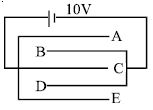
Five identical capacitor plates are arranged such that they make capacitors each of $2\  \mu F$. The plates are connected to a source of $emf$ $10\  V$. The charge on plate $C$ is......$ \mu C$
A negative charge is coming towards the observer. The direction of the magnetic field produced by it will be (as seen by observer)