MCQ
“Stationary waves” are so called because in them
  • A
    The particles of the medium are not disturbed at all
  • B
    The particles of the medium do not execute SHM
  • There occurs no flow of energy along the wave
  • D
    The interference effect can’t be observed

Answer

Correct option: C.
There occurs no flow of energy along the wave
c
(c)

Need a full question paper?

Generate a complete, print-ready paper with questions like this in minutes — across 16+ boards, with answer keys.
Start Generating Free

Similar questions

A stone tied with a string, is rotated in a vertical circle. The minimum speed with which the string has to be rotated
A man can hear sounds in frequency range $120\,Hz$ to $12020\,Hz$. only. He is vibrating a piano string having a tension of $240\,N$ and mass of $3\,gm$ . The string has a length of $8\,m$ . How many different frequencies can he hear ?
The potential energy of a certain particle is given by $U = \frac{1}{2}\,\left( {{x^2} - {z^2}} \right)$. The force on it is 
Aball of mass $m$ collides elastically with an identical ball at rest with some impact parameter.
A cylinder contains $10\, kg$ of gas at pressure of ${10^7}\,\,N/{m^2}.$ The quantity of gas taken out of the cylinder, if final pressure is $2.5 \times {10^6}\,N/{m^2},$ will be ..... $kg$ (Temperature of gas is constant)
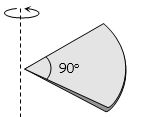
One quarter sector is cut from a uniform circular disc of radius $R$.  This sector has mass $M$. It is made to rotate about a line perpendicular to its plane and passing through the centre of the original disc.  Its moment of inertia about the axis of rotation is
An electron and a proton are moving under the influence of mutual forces. In calculating the change in the kinetic energy of the system during motion, one ignores the magnetic force of one on another. This is because:
The moment of inertia of a regular circular disc of mass $0.4\, kg$ and radius $100\, cm$ about an axis perpendicular to the plane of the disc and passing through its centre is ...... $kg\, m^2$
A student measured the diameter of a wire using a screw gauge with the least count $0.001\, cm$ and listed the measurements. The measured value should be recorded as
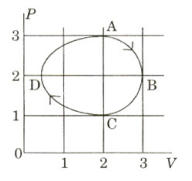
The figure shows the $P-V$ plot of an ideal gas taken through a cycle $ABCDA$. The part $ABC$ is a semi-circle and $CDA$ is half of an ellipse. Then,

$(A)$ the process during the path $\mathrm{A} \rightarrow \mathrm{B}$ is isothermal

$(B)$ heat flows out of the gas during the path $\mathrm{B} \rightarrow \mathrm{C} \rightarrow \mathrm{D}$

$(C)$ work done during the path $\mathrm{A} \rightarrow \mathrm{B} \rightarrow \mathrm{C}$ is zero

$(D)$ positive work is done by the gas in the cycle $ABCDA$