MCQ
Strength of acidity is in order:
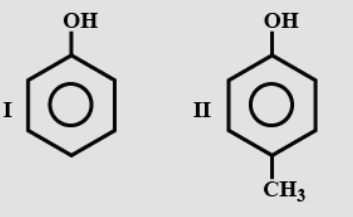
- A$\ce{II>I}$
- ✓$\ce{I>II}$
- C$\ce{I=II}$
- DCan not be determined
Generate a complete, print-ready paper with questions like this in minutes — across 16+ boards, with answer keys.
$2NO_2(g) + O_3(g) \to N_2O_5(g) + O_2(g)$
rate law is $R = K\, [NO_2]' [O_3]'$.
Which of these possible reaction mechanisms is consistent with the rate law?
Mechanism $I :$
$NO_2(g) + O_3(g) \to NO_3(g) + O_2(g)$ (slow)
$NO_3(g) + NO_2(g) \to N_2O_5(g)$ (fast)
Mechanism $II :$
$O_3(g) \rightleftharpoons O_2(g) + [O]$ (fast)
$NO_2(g) + [O] \to NO_3$ (slow)
$NO_3(g) + NO_2(g) \to N_2O_5$ (fast)
($A$) $\mathrm{LiAlH}_4$ in $\left(\mathrm{C}_2 \mathrm{H}_5\right)_2 \mathrm{O}$
($B$) $\mathrm{BH}_3$ in $THF$
($C$) $\mathrm{NaBH}_4$ in $\mathrm{C}_2 \mathrm{H}_5 \mathrm{OH}$
($D$) Raney $\mathrm{Ni} / \mathrm{H}_2$ in $\mathrm{THF}$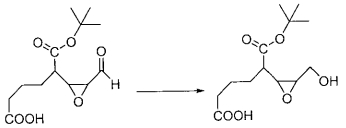
(The freezing point depression constant for water $=2\; \mathrm{K}\; \mathrm{kg} \;\mathrm{mol}^{-1}$ )