MCQ
Strongest bond is
  • A
    $C-C$
  • B
    $C-H$
  • $C-N$
  • D
    $C-O$

Answer

Correct option: C.
$C-N$
c
Multiple bonds have more bond energy so $C \equiv N$ will be the strongest

Need a full question paper?

Generate a complete, print-ready paper with questions like this in minutes — across 16+ boards, with answer keys.

Start Generating Free

Similar questions

Given below are two statements: One is labelled as Assertion $A$ and the other is labelled as Reason $R$:

Assertion $A$: Alcohols react both as nucleophiles and electrophiles.

Reason $R$: Alcohols react with active metals such as sodium, potassium and aluminum to yield corresponding alkoxides and liberate hydrogen.

In the light of the above statements, choose the correct answer from the options given below:

Which of the following configurations represents atoms of the elements having the highest second ionization energy
Which of the following compound is expected to be most basic
Nitrogen dioxide cannot be obtained by heating
The energies of activation for forward and reverse reactions for $A_2 + B_2 \rightleftharpoons  2AB$ are $180\, kJ\, mol^{-1}$ and $200 \,kJ\, mol^{-1}$  respectively. The presence of a catalyst lowers the activation energy of both (forward and reverse) reactions by $100\, kJ\,mol^{-1}.$ The enthalpy change of the reaction $(A_2 + B_2 \rightarrow 2AB)$ in the presence of a catalyst will be ( in $kJ\, mol^{-1}$)
Dilute one litre $1\,molar$  ${H_2}S{O_4}$ solution by $5\,litre$ water, the normality of that solution is ....... $N$
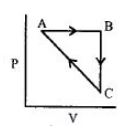
An ideal gas undergoes a cyclic process as shown in Figure

$\Delta {U_{BC}} =  - 5\,kJ\,mo{l^{ - 1}},{q_{AB}} = 2\,kJ\,mo{l^{ - 1}}$

$\Delta {W_{AB}} =  - 5\,kJ\,mo{l^{ - 1}},{W_{CA}} = 3\,kJ\,mo{l^{ - 1}}$ 

Heat absorbed by the system during process $CA$ is......$kJ\,mo{l^{ - 1}}$
Correct statements for an element with atomic number 9 are
A. There can be 5 electrons for which $\mathrm{m}_{\mathrm{s}}=+\frac{1}{2}$ and 4 electrons for which $\mathrm{m}_{\mathrm{s}}=-\frac{1}{2}$
B. There is only one electron in $p_{z}$ orbital
C. The last electron goes to orbital with $\mathrm{n}=2$ and $l=1$
4. The sum of angular nodes of all the atomic orbitals is 1 .
Choose the correct answer from the options given below:
Which one is polar molecule among the following
The total number of molecular orbitals formed from $2 \mathrm{~s}$ and $2 \mathrm{p}$ atomic orbitals of a diatomic molecule