MCQ
Strongest nucleophile in polar protic solvent is
  • A
    ${F^\Theta }$
  • B
    ${Cl^\Theta }$
  • ${I^\Theta }$
  • D
    ${Br^\Theta }$

Answer

Correct option: C.
${I^\Theta }$
c
In polar protic solvents (e.g. water and alcohols, any solvent with $OH$ ) nucleophilicity increases as you go down the periodic table ($F^- \,<\, Cl^-\,<\, Br^-\,<\, I^-$ )

Need a full question paper?

Generate a complete, print-ready paper with questions like this in minutes — across 16+ boards, with answer keys.
Start Generating Free

Similar questions

Identify the correct reactivity order for $E_2$ reaction with alc. $KOH$
Phenol $+ (H-CN+HCl) \xrightarrow[{(2)\,\,{H_2}O}]{{(1)\,ZnC{l_2}}}X$ ; $X$ is
Calculate $x + y + z$ for $H_3PO_3$ acid, where $x$ is number of lone pairs, $y$ is number of $\sigma $ bonds and $z$ is number of $\pi -$ bonds 
The solution which shows negative or positive deviation by Raoult's law, is called
Which of the following has diamagnetic character
Which one of the following is an emulsion?
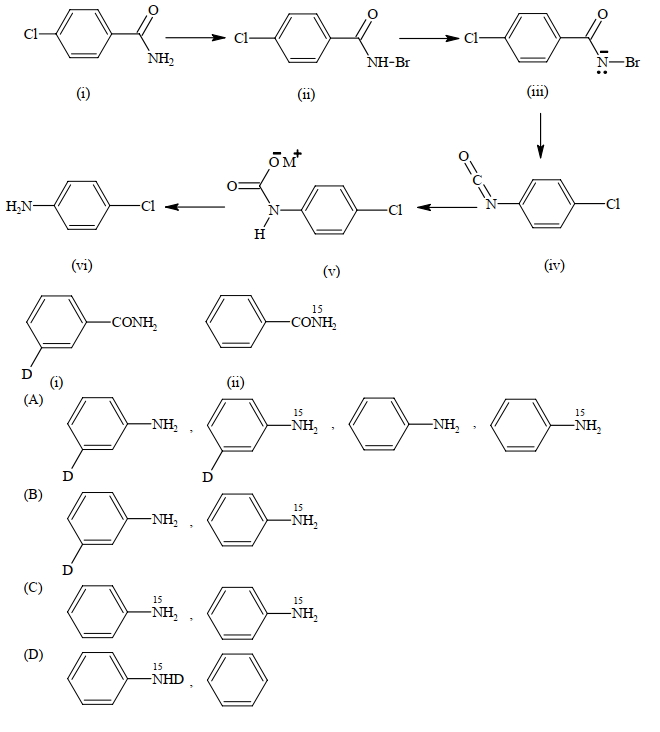
$\mathrm{RCONH}_2$ is converted into $\mathrm{RNH}_2$ by means of Hofmann bromamide degradation.

$Image$

In this reaction, $\mathrm{RCONHBr}$ is formed from which this reaction has derived its name. Electron donating group at phenyl activates the reaction. Hofmann degradation reaction is an intramolecular reaction.

$1.$  How can the conversion of $(i)$ to $(ii)$ be brought about?

$(A)$ $\mathrm{KBr}$  $(B)$ $\mathrm{KBr}+\mathrm{CH}_3 \mathrm{ONa}$  $(C)$ $\mathrm{KBr}+\mathrm{KOH}$  $(D)$ $\mathrm{Br}_2+\mathrm{KOH}$

$2.$  Which is the rate determining step in Hofmann bromamide degradation?

$(A)$ Formation of $(i)$  $(B)$ Formation of $(ii)$  $(C)$ Formation of $(iii)$  $(D)$ Formation of $(iv)$

$3.$  What are the constituent amines formed when the mixture of $(i)$ and $(ii)$ undergoes Hofmann bromamide degradation?

$Image$

give the answer question $1$, $2$, and $3.$
Which of the following is the most suitable classification for $\mathrm{C}_6 \mathrm{H}_5 \mathrm{NHCH}_3?$
Which one of the following bases is not present in $DNA$ ?
Which of the following is most reactive towards ${S_N}^2$ reaction ?