Question
Study the circuits (a) and (b) shown in Fig. and answer the following questions.
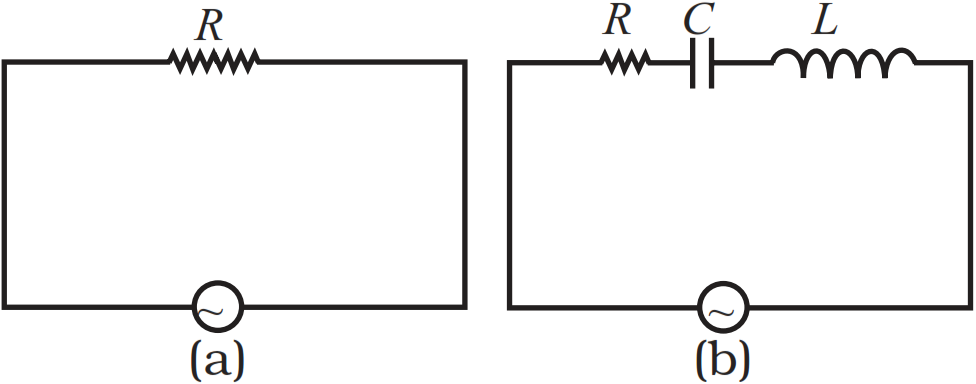
  1. Under which conditions would the rms currents in the two circuits be the same?
  2. Can the rms current in circuit (b) be larger than that in (a)?
Answer


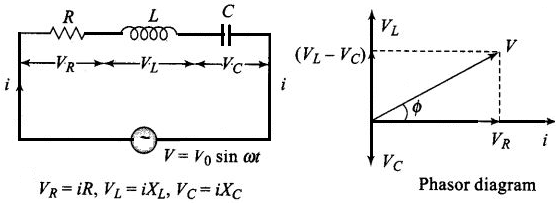
Key concept: Series RLC - Circuit
  1. Equation of current: $\text{i}=\text{i}_0\sin(\omega\text{t}\pm\phi);\text{ where i}_0=\frac{\text{V}_0}{\text{Z}}$
  2. Equation of vpltage: From phasor diagram $\text{V}=\sqrt{\text{V}^2_\text{R}+(\text{V}_\text{L}-\text{V}_\text{C})^2}$
  3. Impedance of the circuit: $\text{Z}=\sqrt{\text{R}^2(\text{X}_\text{L}-\text{X}_\text{C})^2}=\sqrt{\text{R}^2+\Big(\omega\text{L}-\frac{1}{\omega\text{C}}\Big)^2}$
  4. Phase difference: From phasor diagram $\tan\phi=\frac{\text{V}_\text{L}-\text{V}_\text{C}}{\text{V}_\text{R}}=\frac{\text{X}_\text{L}-\text{X}_\text{L}}{\text{R}}=\frac{\omega\text{L}-\frac{1}{\omega\text{C}}}{\text{R}}=\frac{2\pi\text{vL}-\frac{1}{2\pi\text{vC}}}{\text{R}}$
  5. If net reactance is inductive: Circuit behaves as LR circuit
  6. If net reactance is capacitive: Circuit begaves as CR circuit
  7. If net reactance is zero: Means $X = X_L - X_C = 0 \Rightarrow X_L = X_C$​​​​​​​, This is the condition of resonance.
  8. At resononce (series resonant circuit),
  1. $X_L = X_C \Rightarrow Z_{min} = R,$ i.e., circuit behaves as a resistive circuit.
  2. $V_L = V_C \Rightarrow V = V_R$, i.e., whole
  3. applied voltage appeared across the resistance.
  4. Phase difference: $\phi=0^\circ\Rightarrow\ \text{p.f.}=\cos\phi=1$
  5. Power consumption: $\text{P}=\text{V}_\text{rms}\text{i}_\text{rms}=\frac{1}{2}\text{V}_0\text{i}_0$
  6. Current in the circuit is maximum and it is $\text{i}_0=\frac{\text{V}_0}{\text{R}}$
Let us first assume, rms current in circuit $A = (I_{rms}) A$
And rms current in circuit $B = (I_{rms}) B$
$(\text{I}_\text{rms})\text{A}=\frac{\text{E}_\text{rms}}{\text{Z}}=\frac{\text{E}_\text{rms}}{\text{R}}$
$(\text{I}_\text{rms})\text{B}=\frac{\text{E}_\text{rms}}{\text{Z}}=\frac{\text{E}_\text{rms}}{\sqrt{\text{R}^2+(\text{X}_\text{L}-\text{X}_\text{C})^2}}$
  1. When $(I_{rms})A = (I_{rms})B$
$\text{R}=\sqrt{\text{R}^2+(\text{X}_\text{L}-\text{X}_\text{C})^2}$
$\Rightarrow X_L = X_C,$ resonance condition
If Erms in the two circuit are same, then at resonance the rms currnet in LCR will be same as that in R circuit (circuit A).
  1. As $\text{Z}\geq\text{R}$
$\Rightarrow\ \frac{(\text{I}_\text{rms})_\text{B}}{(\text{I}_\text{rms})_\text{A}}=\frac{\frac{\text{E}_\text{rms}}{\text{Z}}}{\frac{\text{E}_\text{rms}}{\text{R}}}=\frac{\text{R}}{\sqrt{\text{R}^2}(\text{X}_\text{L}-\text{X}_\text{C})^2}=\frac{\text{R}}{\text{Z}}\leq1$
$\Rightarrow\ (\text{I}_\text{rms})\text{a}\geq(\text{I}_\text{rms})\text{b}$
No, $\text{R}\leq\text{Z}$. So, rms current in circuit (b) cannot be larger than that in (a).

Need a full question paper?

Generate a complete, print-ready paper with questions like this in minutes — across 16+ boards, with answer keys.

Start Generating Free

Similar questions

In Fig. the energy stored in $C _4$ is $27 J$ . Calculate the total energy stored in the system.
Image
Consider $N = n_1n_2$ identical cells, each of emf $\in$ and internal resistance r. Suppose $n_1$ cells are joined in series to form a line and $n_2$ such lines are connected in parallel. The combination drives a current in an external resistance R. (a) Find the current in the external resistance. (b) Assuming that $n_1$ and $n_2$ can be continuously varied, find the relation between $n_1, n_2, R$ and r for which the current in R is maximum.
Four charges $+ q ,+ q ,- q$ and $- q$ are placed respectively at the corners $A , B , C$ and $D$ of a square of side a arranged in the given order. Calculate the electric potential at the centre $O$ . If A a $E$ and $F$ are the midpoints of sides $BC$ and $CD$ respectively, what will be the work done in carrying a charge e from $O$ to $E$ and from $O$ to $F$ ?
Image
A source of sound operates at 2.0kHz, 20W emitting sound uniformly in all directions. The speed of sound in air is 340m/s and the density of air is $1.2kg/m^3.$
  1. What is the intensity at a distance of 6.0m from the source?
  2. What will be the pressure amplitude at this point?
  3. What will be the displacement amplitude at this point ?
Define magnifying power of a telescope. Write its expression.
A small telescope has an objective lens of focal length 150 cm and an eye piece of focal length 5 cm. If this telescope is used to view a 100m high tower 3 km away, find the height of the final image when it is formed 25 cm away from the eye piece.
  1. An electron moves along a circle of radius 1m in a perpendicular magnetic field of strength 0.50T. What would be its speed? Is it reasonable?
  2. If a proton moves along a circle of the same radius in the same magnetic field, what would be its speed?
  1. Two insulated charged copper spheres A and B have their centres separated by a distance of 50 cm. What is the mutual force of electrostatic repulsion if the charge on each is $6.5 \times 10^{-7}$ C? The radii of A and B are negligible compared to the distance of separation.
  2. What is the force of repulsion if each sphere is charged double the above amount, and the distance between them is halved?
A pendulum bob of mass 80mg and carrying a charge of $2 \times 10^{-8}C$ is at rest in a uniform, horizontal electric field of $20kVm^{-1}.$ Find the tension in the thread.
In a Young's double slit experiment, the separation between the slits = 2.0mm, the wavelength of the light = 600nm and the distance of the screen from the slits = 2.0m. If the intensity at the centre of the central maximum is $0.20W/ m^2$, what will be the intensity at a point 0.5cm away from this centre along the width of the fringes?
What are the dimensions of $\chi$, the magnetic susceptibility? Consider an H-atom. Guess an expression for $\chi$, upto a constant by constructing a quantity of dimensions of $\chi$, out of parameters of the atom: e, m, v, R and $\mu _0$ . Here, m is the electronic mass, v is electronic velocity, R is Bohr radius. Estimate the number so obtained and compare with the value of $|\chi|\sim10^{-5}$ for many solid materials.