Question
Study the circuits (a) and (b) shown in Fig. and answer the following questions.
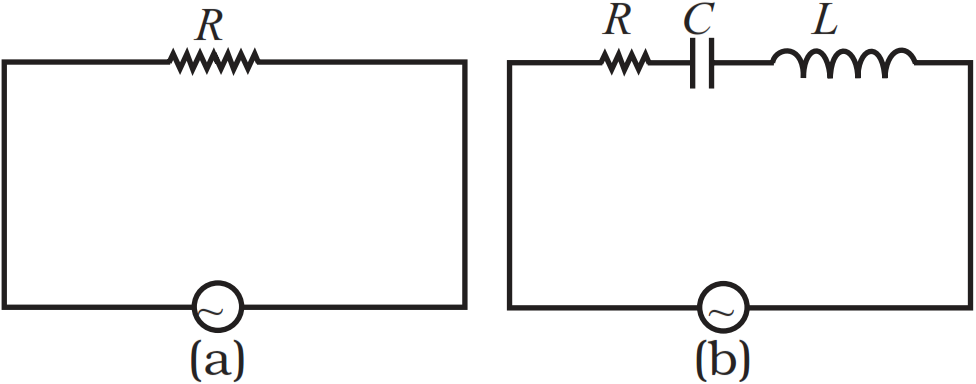
  1. Under which conditions would the rms currents in the two circuits be the same?
  2. Can the rms current in circuit (b) be larger than that in (a)?
Answer

Key concept: Series RLC - Circuit

  1. Equation of current: $\text{i}=\text{i}_0\sin(\omega\text{t}\pm\phi);\text{ where i}_0=\frac{\text{V}_0}{\text{Z}}$
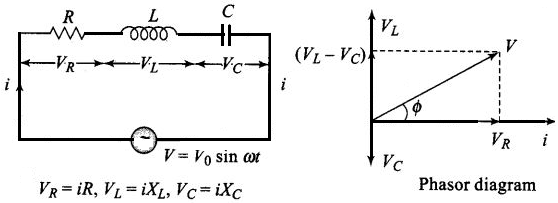
  2. Equation of vpltage: From phasor diagram $\text{V}=\sqrt{\text{V}^2_\text{R}+(\text{V}_\text{L}-\text{V}_\text{C})^2}$
  3. Impedance of the circuit: $\text{Z}=\sqrt{\text{R}^2(\text{X}_\text{L}-\text{X}_\text{C})^2}=\sqrt{\text{R}^2+\Big(\omega\text{L}-\frac{1}{\omega\text{C}}\Big)^2}$
  4. Phase difference: From phasor diagram $\tan\phi=\frac{\text{V}_\text{L}-\text{V}_\text{C}}{\text{V}_\text{R}}=\frac{\text{X}_\text{L}-\text{X}_\text{L}}{\text{R}}=\frac{\omega\text{L}-\frac{1}{\omega\text{C}}}{\text{R}}=\frac{2\pi\text{vL}-\frac{1}{2\pi\text{vC}}}{\text{R}}$
  5. If net reactance is inductive: Circuit behaves as LR circuit
  6. If net reactance is capacitive: Circuit begaves as CR circuit
  7. If net reactance is zero: Means X = XL - XC = 0 ⇒ XL = XC, This is the condition of resonance.
  8. At resononce (series resonant circuit),
  1. XL = XC ⇒ Zmin = R, i.e., circuit behaves as a resistive circuit.
  2. VL = VC ⇒ V = VR, i.e., whole applied voltage appeared across the resistance.
  3. Phase difference: $\phi=0^\circ\Rightarrow\ \text{p.f.}=\cos\phi=1$
  4. Power consumption: $\text{P}=\text{V}_\text{rms}\text{i}_\text{rms}=\frac{1}{2}\text{V}_0\text{i}_0$
  5. Current in the circuit is maximum and it is $\text{i}_0=\frac{\text{V}_0}{\text{R}}$

Let us first assume, rms current in circuit A = (Irms) A

And rms current in circuit B = (Irms) B

$(\text{I}_\text{rms})\text{A}=\frac{\text{E}_\text{rms}}{\text{Z}}=\frac{\text{E}_\text{rms}}{\text{R}}$

$(\text{I}_\text{rms})\text{B}=\frac{\text{E}_\text{rms}}{\text{Z}}=\frac{\text{E}_\text{rms}}{\sqrt{\text{R}^2+(\text{X}_\text{L}-\text{X}_\text{C})^2}}$

  1. When (Irms)A = (Irms)B

$\text{R}=\sqrt{\text{R}^2+(\text{X}_\text{L}-\text{X}_\text{C})^2}$

⇒ XL = XC, resonance condition

If Erms in the two circuit are same, then at resonance the rms currnet in LCR will be same as that in R circuit (circuit A).

  1. As $\text{Z}\geq\text{R}$

$\Rightarrow\ \frac{(\text{I}_\text{rms})_\text{B}}{(\text{I}_\text{rms})_\text{A}}=\frac{\frac{\text{E}_\text{rms}}{\text{Z}}}{\frac{\text{E}_\text{rms}}{\text{R}}}=\frac{\text{R}}{\sqrt{\text{R}^2}(\text{X}_\text{L}-\text{X}_\text{C})^2}=\frac{\text{R}}{\text{Z}}\leq1$

$\Rightarrow\ (\text{I}_\text{rms})\text{a}\geq(\text{I}_\text{rms})\text{b}$

No, $\text{R}\leq\text{Z}$. So, rms current in circuit (b) cannot be larger than that in (a).

Need a full question paper?

Generate a complete, print-ready paper with questions like this in minutes — across 16+ boards, with answer keys.

Start Generating Free

Similar questions

An inductor of inductance 5.0H, having a negligible resistance, is connected in series with a $100\Omega$ resistor and a battery of emf 2.0V. Find the potential difference across the resistor 20ms after the circuit is switched on.
A smooth wedge A is fitted in a chamber hanging from a fixed ceiling near the earth's surface. A block B placed at the top of the wedge takes a time T to slide down the length of the wedge. If the block is placed at the top of the wedge and the cable supporting the chamber is broken at the same instant, the block will:
  1. Take a time longer than T to slide down the wedge.
  2. Take a time shorter than T to slide down the wedge.
  3. Remain at the top of the wedge.
  4. Jump off the wedge.
A stone is thrown vertically upward with a speed of 28m/s.
  1. Find the maximum height reached by the stone.
  2. Find its velocity one second before it reaches the maximum height.
  3. Does the answer of part.
  4. Change if the initial speed is more than 28m/s suchas 40m/s or 80m/s?
In an experiment on photoelectric effect, the stopping potential is measured for monochromatic light beams corresponding to different wavelengths. The data collected are 11s follows:

wavelength (nm) 350 400 450 500 550
stopping potential(V): 1.45 1.00 0.66 0.38 0.16

Plot the stopping potential against inverse of wavelength $\big(\frac{1}{\lambda}\big) $ on a graph paper and find

  1. The Planck constant,
  2. The work function of the emitter and.
  3. The threshold wavelength.
Explain oscillating action of a n-p-n transistor with circuit diagram.
Are the nucleons fundamental particles, or do they consist of still smaller parts? One way to find out is to probe a nucleon just as Rutherford probed an atom. What should be the kinetic energy of an electron for it to be able to probe a nucleon? Assume the diameter of a nucleon to be approximately 10-15m.
A voltmeter coil has resistance $50.0\Omega$ and a resistor of $1.15\text{k}\Omega$ is connected in series. It can read potential differences up to 12 volts. If this same coil is used to construct an ammeter that can measure currents up to 2.0A, what should be the resistance of the shunt used?
Suppose India had a target of producing by 2020 AD, 200,000 MW of electric power, ten percent of which was to be obtained from nuclear power plants. Suppose we are given that, on an average, the efficiency of utilization (i.e. conversion to electric energy) of thermal energy produced in a reactor was 25%. How much amount of fissionable uranium would our country need per year by 2020? Take the heat energy per fission of $^{235}\text{U}$ to be about 200MeV.
A nuclide 1 is said to be the mirror isobar of nuclide 2 if Z1 =N2 and Z2 =N1.
  1. What nuclide is a mirror isobar of 1123Na?
  2. Which nuclide out of the two mirror isobars have greater binding energy and why?
A parallel-plate capacitor has plate area 100cm2 and plate separation 1.0cm. A glass plate (dielectric constant 6.0) of thickness 6.0mm and an ebonite plate (dielectric constant 4.0) are inserted one over the other to fill the space between the plates of the capacitor. Find the new capacitance.