Question
Study the diagram given below:
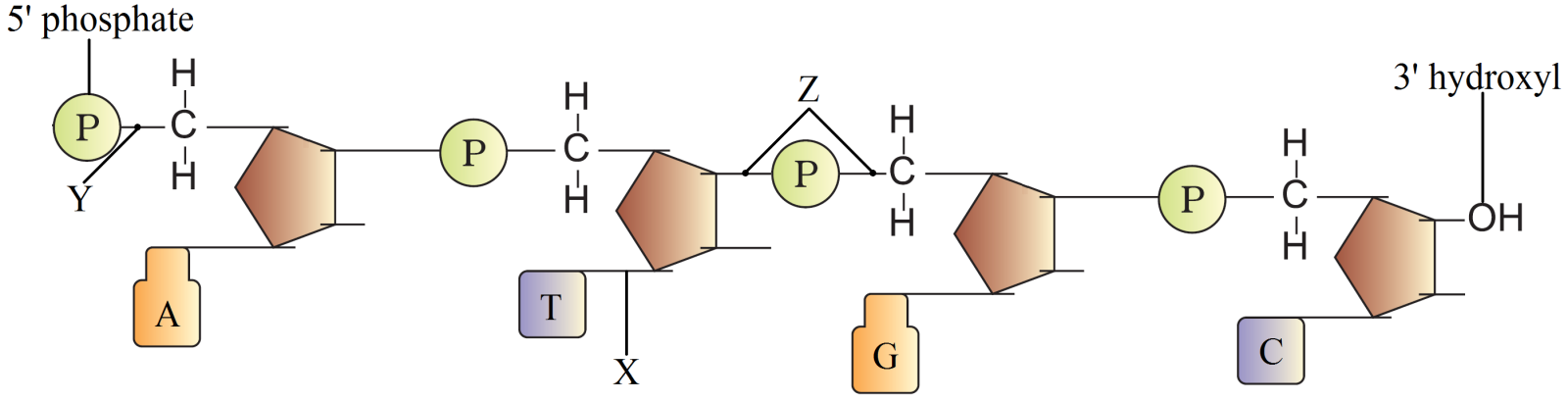
Name the linkages X, Y, Z and the respective molecules formed by them.

Answer

  1. X is N-glycosidic linkage; it forms a nucleoside.
  2. Y is phosphoester linkage; it forms a nucleotide.
  3. Z is a phosphodiester linkage; it forms a dinucleotide.

Need a full question paper?

Generate a complete, print-ready paper with questions like this in minutes — across 16+ boards, with answer keys.

Start Generating Free

Similar questions

Your classmate complains of headache and cough. The doctor confirms that he is suffering from Pneumonia and not common cold, on the basis of certain symptoms. List these symptoms. Mention any two precautions to be followed to prevent the spread of this disease.
Both a wine maker and a molecular biologist who had developed a recombinant vaccine claim to be biotechnologists. Who in your opinion is correct?
Answer the following questions:
Give two reasons why Mendel selected garden pea for his experiments. Give the biological name of this plant.
Autotrophs convert inorganic materials into organic material with the help of solar energy.
  1. Name the process depicted by the given statement.
  2. Name the pigment which traps solar energy and convert light energy to chemical energy.
  3. What do you understand by a photosynthetic unit?
$6\text{CO}_2+12\text{H}_2\text{O}\xrightarrow{\text{Light}}\text{C}_6\text{H}_{12}\text{O}+6\text{H}_2\text{O}+6\text{O}_2$
  1. Name any two fowls other than chicken reared in a poultry farm.
  2. Enlist four important components of poultry farm management.
Describe which is the second effective and popular method of contraception in India.
Draw a diagram of L. S. of an anatropous ovule of an angiosperm and label the following parts.
  1. Nucellus.
  2. Integument.
  3. Antipodal cells.
  4. Secondary nucleus.
"Post-industrialization, the population of melanised moth increased in England at the expense of white-winged moths." Provide explanations.
When and where do chorionic villi appear in humans? State their functions.
What is apomixis and what is its importance?