Question
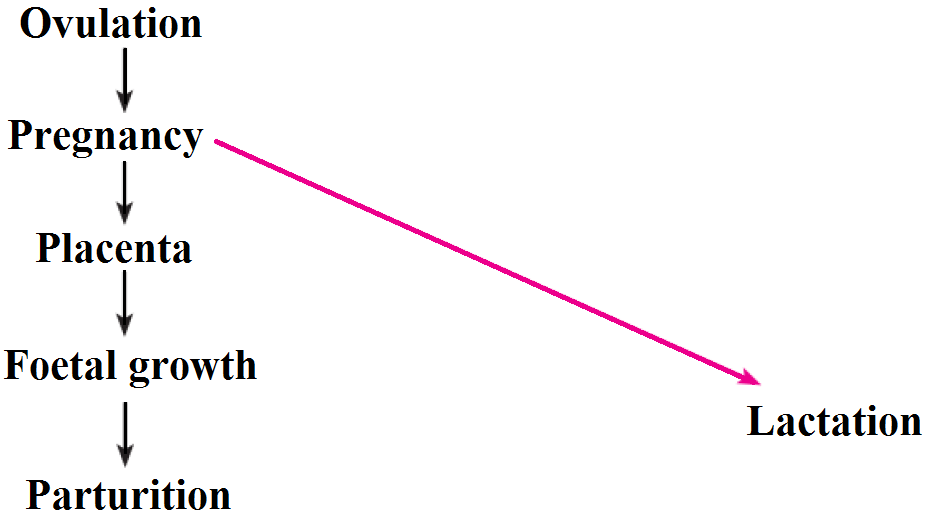
Study the flow chart given below. Name the hormones involved at each stage and explain their role.
Answer

  • Rapid release of luteinising hormone ruptures Graafian follicle and release ovum (ovulation).
  • Corpus luteum secretes large amount of progesterone hormone that is essential for maintenance of the endometrium required for implantation of blastocyst leading to pregnancy.
  • Placenta produces several hormones like human chorionic gonadotropin (hCG), human placental lactogen (hPL). Relaxin is also produced during later phase of pregnancy. Level of other hormones like estrogens, progestogens, cortisol, prolactin and thyroxine also increases which is essential for supporting fetal growth, metabolic changes in mother and maintenance of pregnancy.
  • Parturition signals originate from the fully developed foetus and the placenta induce mild uterine contractions which triggers release of oxytocin from pituitary. Oxytocin acts on the uterine muscle causing stronger uterine contractions.

Need a full question paper?

Generate a complete, print-ready paper with questions like this in minutes — across 16+ boards, with answer keys.

Start Generating Free

Similar questions

"It is often said that the pyramid of energy is always upright. On the other hand, the pyramid of biomass can be both upright and inverted." Explain with the help of examples and sketches.
Describe the main ideas behind the biological control of pests and diseases.
  1. Draw a simplified model of phosphorus cycling in a terrestrial ecosystem.
  2. Write the importance of such cycles in ecosystems.
Explain the development of a secondary oocyte (ovum) in a human female from the embryonic stage upto its ovulation. Name the hormones involved in this process.

OR

When does oogenesis start in humans? Name the three hormones and their sources, linked with oogenesis. How do they influence the process of oogenesis? Explain.

State the laws of inheritance that can be derived from such a cross.
Differentiate between:
  1. Predator and parasite.
  2. S-Shaped and J-Shaped growth curve.
“Phenylketonuria is a good example that explains Pleiotropy.” Justify.
  1. Draw the embryo sac of a flowering plant and label:
  1. Central cell
  2. Chalazal end of the embryo sac
  3. Synergids.
  1. Name the cell that develops into the embryo sac and explain how this cell leads to the formation of embryo sac. Also mention the role played by the various cells of the embryo sac.
During the course of evolution why DNA was chosen over RNA as genetic material? Give reasons by first discussing the desired criteria in a molecule that can act as genetic material and in the light of biochemical differences between DNA and RNA.
Define transcription. Write the names of the parts of the transcription unit in DNA. Draw a schematic diagram of the transcription unit.