Question
Study the given pedigree chart and answer the questions that follow.
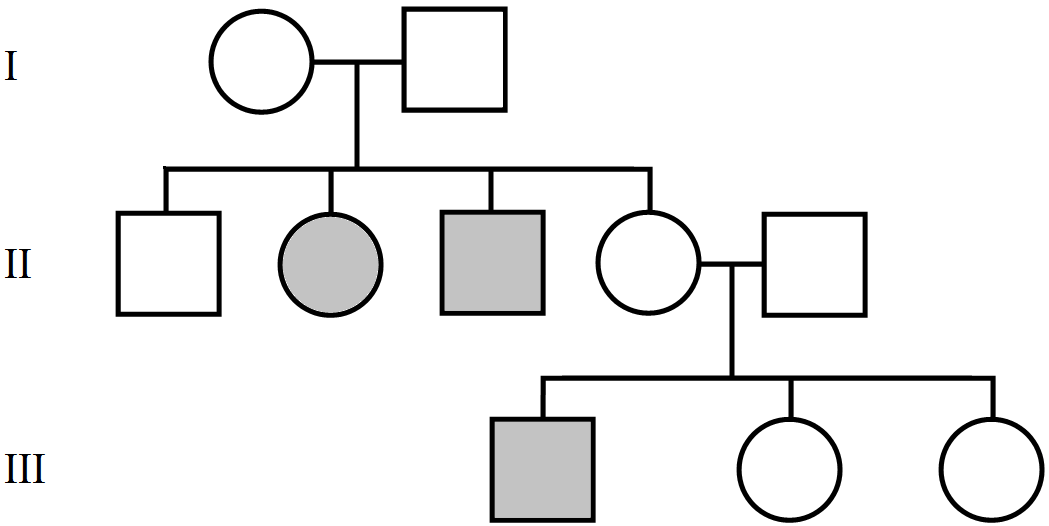
  1. Is the trait recessive or dominant?
  2. Is the trait sex linked or autosomal?
  3. Give the genotypes of the parents in generation I and of their third and fourth child in generation II.

Answer

If we take A and a as the traits:
  1. Recessive.
  2. Autosomal.
  3. Parents-Aa and Aa.
Third child-aa.

Fourth child-Aa.

Need a full question paper?

Generate a complete, print-ready paper with questions like this in minutes — across 16+ boards, with answer keys.

Start Generating Free

Similar questions

Write the specific symptoms of acquired immunity.
In an aquarium two herbivorous species of fish are living together and feeding on phytoplanktons. As per the Gause’s Principle, one of the species is to be eliminated in due course of time, but both are surviving well in the aquarium. Give possible reasons.
What is adaptive radiation? Explain with examples.
Classify the following as examples of homology and analogy:
  1. Mouth parts of cockroach and butterfly.
  2. Hearts of rabbits and human beings.
  3. Eyes of octopus and mammals.
  4. Sweet potato and potato.
  5. Stings of honeybee and scorpion.
  6. Tendrils of Lathyrus and tendrils of Gloriosa.
In relation to energy transfer in ecosystem, explain the statement "10kg of deer's meat is equivalent to 1kg of lion's flesh".
The present population growth rate in India is alarming. Suggest ways to check it.
$F_1$ progeny of pea plant bearing violet flowers and snapdragon plant bearing red flowers were selfed to produce their respective $F_2$ progeny. Compare the phenotypes, the genotypes and the pattern of inheritance of their respective $F_2$ progeny.
What are the limitations of ecological pyramids?
Digrammatically represent the experimental steps in cloning and expressing an human gene (say the gene for growth hormone) into a bacterium like E. coli ?
Classify the following as examples of homology and analogy:
(i) Mouth parts of cockroach and butterfly
(ii) Hearts of rabbits and human beings
(iii) Eyes of octopus and mammals
(iv) Sweet potato and potato
(v) Stings of honey bee and scorpion
(vi) Tendrils of Lathyrus and tendrils of Gloriosa