Question
Study the graph given below and answer the questions that follow:
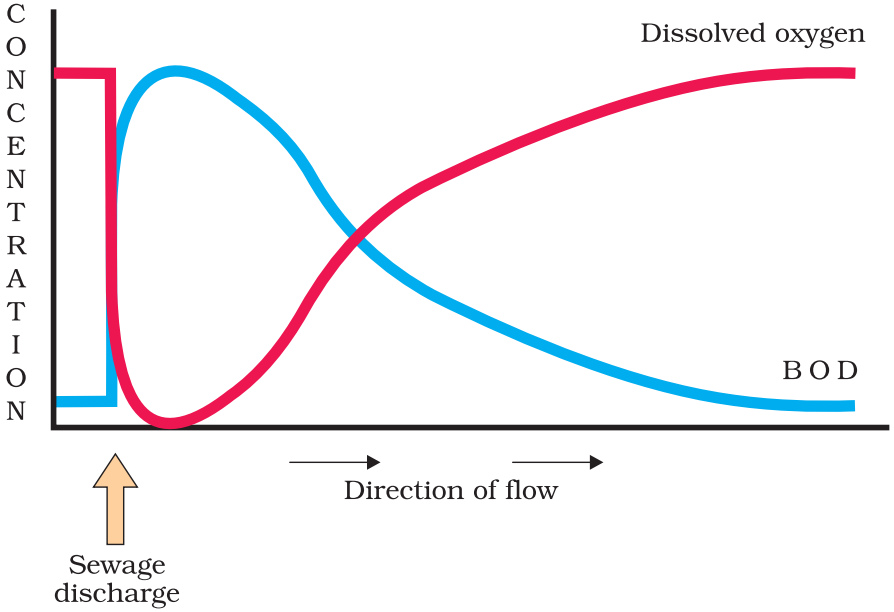
  1. What is the relationship between dissolved oxygen and biochemical oxygen demand (BOD)?
  1. Mention their effect on aquatic life in the river.

Answer

  1. When BOD is high, dissolved $O_2$ is less/ inversely proportional.
  2. If dissolved $O_2$ is less and BOD is high, aquatic organisms die.
If dissolved $O_2$ is more and BOD is low, fresh water organisms reappear.

Need a full question paper?

Generate a complete, print-ready paper with questions like this in minutes — across 16+ boards, with answer keys.

Start Generating Free

Similar questions

Write about application and future challanges of HGP
Explain how the inflow of large amount nutrients like phosphates and nitrates into the water body drastically affect the aquatic life there. Name the phenomenon responsible.
OR
'Fish mortality increases with the influx of nutrients in a freshwater body.' Write two reasons. How will the influx of nutrients affect the BOD level of this water body?

OR
How is it that the mortality rate of fish increases downstream from the point of sewage discharge into a water body? Explain.
What is natural ecosystem? Explain with the help of suitable example.
Write a note on medicinal value of biodiversity.
The pyramid of energy is always upright. Why?
Write the most important characteristic that Aspergillus niger, Clostridium butylicum, and Lactobacillus share.
How and why is the bacterium Thermus aquaticus employed in DNA technology? Explain.
Or
Name the source of the DNA polymerase used in PCR technique. Mention why it is used?

Or
Give the name of the organism from where the thermostable DNA polymerase is isolated. State its role in genetic engineering.
What would happen to the successive trophic levels in the pyramid of energy if the rate of reproduction of phytoplankton was slowed down? Suggest two factors, which could cause such a reduction in phytoplankton reproduction.
Differentiate between ‘ZZ’ and ‘XY’ type of sex-determination mechanisms.
Distinguish between the roles of flocs and anaerobic sludge digesters in sewage treatments.