Question
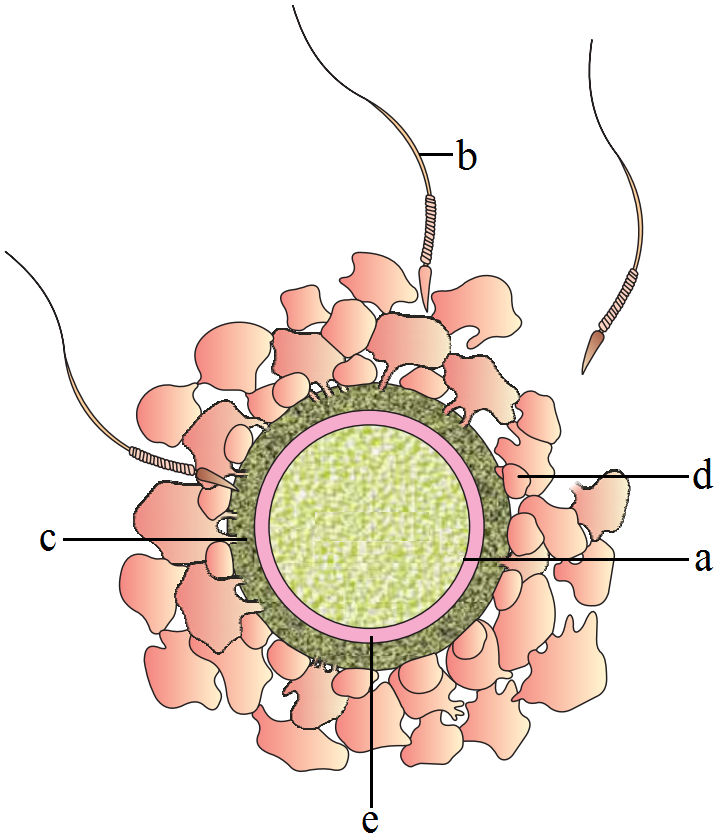
Study the illustration given and answer the questions that follow:
Identify ‘d’.

Answer

d – cells of corona radiata.

Need a full question paper?

Generate a complete, print-ready paper with questions like this in minutes — across 16+ boards, with answer keys.
Start Generating Free

Similar questions

The biology teacher asked her students to verify the experiment on transformation principle in bacteria to establish DNA as genetic material. The class was divided into two groups. The teacher asked them to submit the reports. Group 2 did not use mouse and did not repeat Griffith's experiment. The teacher praised them.
  1. Which experiment did they perform?
  2. Explain the experiment in brief.
  3. Who and when performed the transformation principle experiment?
  4. What values did students of group 2 exhibit?
Name and state the law that can be derived from this cross and not from a monohybrid cross.
What is cancer? How is a cancer cell different from normal cell? How do normal cells attain cancerous nature?
Answer the following questions.
Explain the events taking place at the time of fertilisation of an ovum in a human female.
Gene expression can be controlled with the help of RNA. Explain the method with an example.
  1. Explain a monohybrid cross taking seed coat colour as a trait in Pisum sativum. Work out the cross upto $F_2$ generation.
  2. State the laws of inheritance that can be derived from such a cross.
  3. How is the phenotypic ratio of $F_2$ generation different in a dihybrid cross?
A pregnant woman was adviced to undergo medical termination of pregnancy. Her doctor found that the foetus in her womb was developed from a zygote made of an XX egg fertilized by a Y-bearing sperm? Why was she advised to undergo MTP?
Two heterozygous parents are crossed. If the two loci are linked what would be the distribution of phenotypic features in $F_1$ generation for a dibybrid cross?
Describe the functions of the following:
Seminiferous tubules.
Explain the steps involved in a polypeptide synthesis. How are the amino acids activated during polypeptide synthesis?