Question
Study the passage given below and answer the questions that follow:
India adopted a democratic approach to the question of diversity. Democracy allows the political expressions of regional aspirations and does not look upon them as anti-national. Besides, democratic politics allows parties and groups to address the people on the basis of their regional identity, aspirations and specific regional problems.
  1. Which type of diversity exists in India?
  2. Name any two political parties that represent regional identity.
  3. Mention any one movement that expresses regional aspirations.
  4. How does democracy treat the regional issues and problems?
Answer

  1. Cultural.
  2. Congress and B.J.P.
  3. Democracy allows the political expression of regional aspirations and does not look upon them as anti-national.
  4. Democratic politics allows parties and groups to address the people on the basis of their regional identity, aspirations and specific regional problems.

Need a full question paper?

Generate a complete, print-ready paper with questions like this in minutes — across 16+ boards, with answer keys.

Start Generating Free

Similar questions

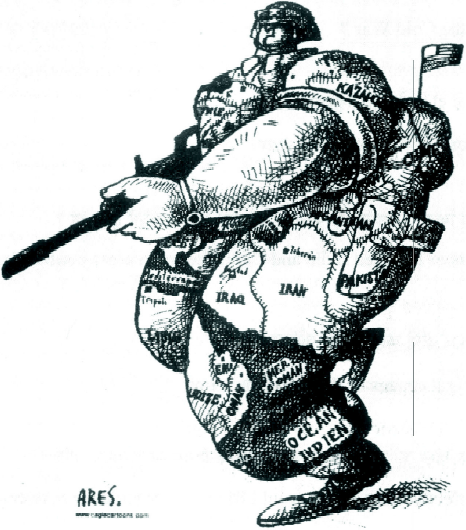
Study the cartoon given above and answer the following questions:
  1. Which country is represented by this mighty soldier?
  2. Why have the names of so many countries been written on the uniform of the soldier?
  3. What message does this cartoon convey to the international community?
State the two main expectations on the basis of which the United Nations was formed in 1945. Mention any two organs and agencies each of the UN.
What were the major conflicts between the parliament and the judiciary during the leadership of Indira Gandhi.
Evaluate the role of “Naxalite Movement in India”.
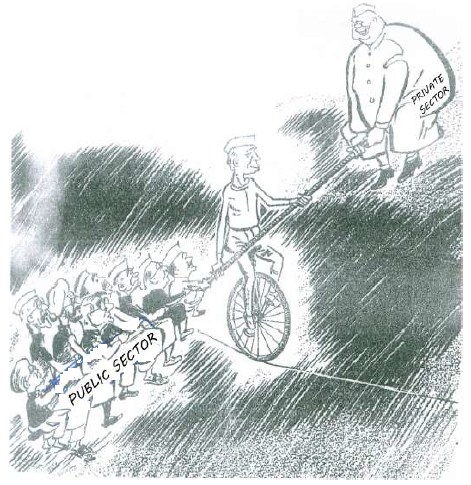
Study the cartoon given below carefully and answer the questions that follow:
  1. Identify and name the person who is holding the balancing beam between the public sector and the private sector.
  2. Why has a big tilt towards the public sector been shown in the cartoon?
  3. How did the over-emphasis on public sector adversely affect the Indian economy?
Analyse the circumstances which led to a severe food shortage and famine-like conditions in many parts of the country in 1960s. Which state of India suffered the most and how? Explain.
Examine the three main reasons responsible for the split in the Congress party during 1969.
Explain any two positive and any two negative effects of globalisation.
Globalisation does not always reduce state capacity. The primacy of the state continues to be the unchallenged basis of the political community. The old jealousies and rivalries between countries have not ceased to matter in world politics. The state continues to discharge its essential functions ( law and order, national security) and consciously withdraws from certain domains from which its wishes to. State continue to be important.
Indeed, in some respect state capacity has received a boost as a consequence of globalisation, with enhanced technologies available at the disposal of the state to collect information about its citizens.
Read the passage given above carefully and answer the following questions:-
  1. What are the two most essential functions of the state?
  2. How do enhanced technologies enable the state to rule better?
  3. Justify with the help of an example that globalisation gives a boost to the state capacity.
Why did the Soviet Union, the second most powerful country in the world, disintegrate? Explain any six reasons.