Question
Study the pedigree chart given below, showing the inheritance pattern of blood groups in a family and answer the given questions.
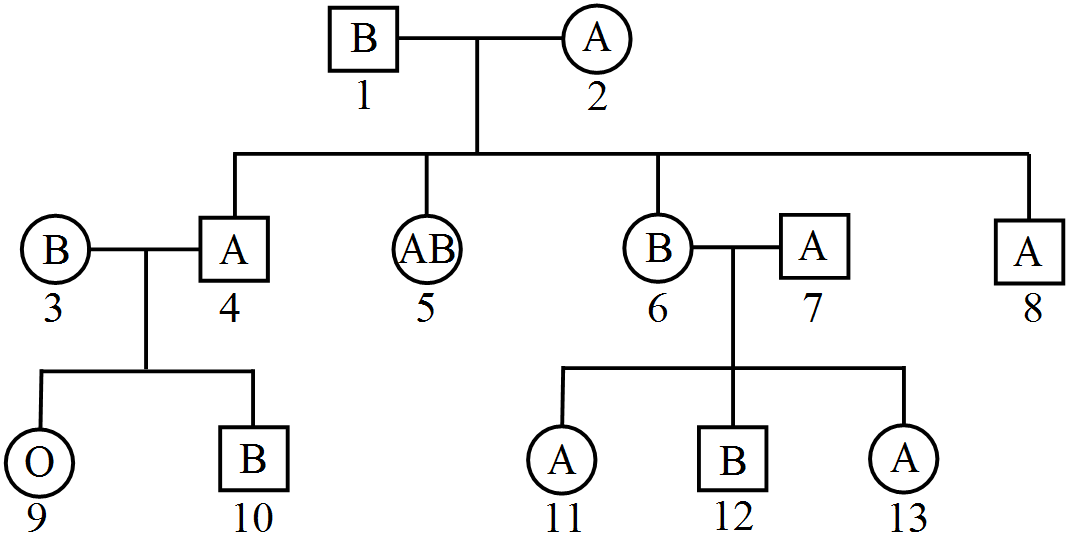
  1. Give the possible genotypes of the individuals 1 and 2.
  2. Which antigen will be present on the plasma membrane of RBCs of individuals 5 and 9?
  3. Give the genotypes of the individuals 3 and 4.
Answer

  1. 1 - IBi
  2. 5 has antigen A and B.

9 has no antigen.

  1. 3 - IBi

4 - IAi

Need a full question paper?

Generate a complete, print-ready paper with questions like this in minutes — across 16+ boards, with answer keys.

Start Generating Free

Similar questions

Draw and label the enlarged view of microsporangium of an Angiosperm. State the function of its innermost wall layer.
Explain artificial synthesis of the compound used by diabetic patients.
What is the association between the bumblebee and its favourite orchid Ophrys? How would extinction or change of one affect the other?
How is the entry of only one sperm and not many ensured into an ovum during fertilisation in humans?
Name any six venereal diseases.
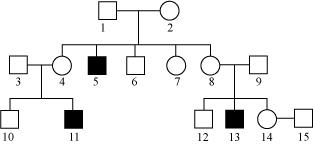
Haemophilia is a sex-linked recessive disorder of humans. The pedigree chart given below shows the inheritance of haemophilia in one family. Study the pattern of inheritance and answer the questions given.

  1. Give all the possible genotypes of the members 4; 5 and 6 in the pedigree chart.
  2. A blood test shows that the individual 14 is a carrier of haemophilia. The member numbered 15 has recently married the member numbered 14. What is the probability that their first child will be a haemophilia male?
During a school trip to ‘Rohtang Pass’, one of your classmate suddenly developed ‘altitude sickness’. But, she recovered after some time.
  1. Mention one symptom to diagnose the sickness.
  2. What caused the sickness?
  3. How could she recover by herself after some time?
Rearrange Ramapithecus, Australopithecus and Homo habilis in the order of their evolution on the Earth. Comment on their evolutionary characteristics.
Classify the following as examples of homology and analogy:
(i)Mouth parts of cockroach and butterfly
(ii)Hearts of rabbits and human beings
(iii)Eyes of octopus and mammals
(iv)Sweet potato and potato
(v)Stings of honey bee and scorpion
(vi)Tendrils of Lathyrus and tendrils of Gloriosa
  1. Why are transgenic animals so called?
  2. Explain the role of transgenic animals in (i) Vaccine safety and (ii) Biological products with the help of an example each.